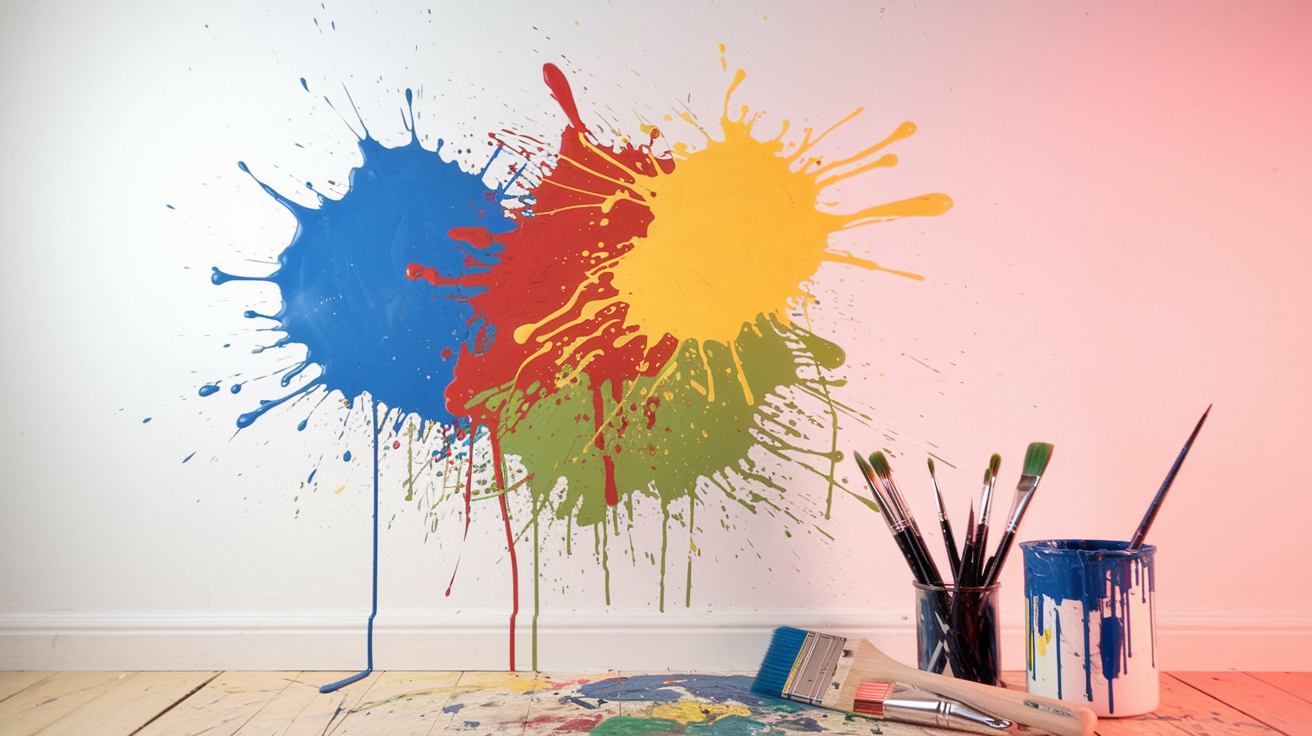
The paint splatter wall at Sunset Gardens Nursing Home started as an accident. A can of paint tipped during renovations, creating a vivid blue burst across the community room's white wall. When Director Patricia saw it, instead of repainting, she had an idea.
“What if we keep it?” she suggested. “Make it intentional?”
Now, six months later, the wall was a constellation of colors, each splatter a story, an emotion, a moment captured in pigment and force.
Seventeen-year-old Jamie hadn't expected to find meaning in paint splatters when she started volunteering to complete her service hours. She'd expected to play cards, maybe read to residents. She hadn't expected Harold.
Harold Williams sat in his wheelchair by the window every Tuesday when she arrived, watching the paint wall with intense focus. At ninety-one, a stroke had stolen his words five years ago. His daughter had warned Jamie: “He understands everything but can't speak. It frustrates him. Don't take it personally if he seems angry.”
But Harold didn't seem angry to Jamie. He seemed trapped, like a fully conscious person locked in a communication-proof box.
Her first day, Jamie watched Recreation Therapist Steven demonstrate the paint splatter activity. “It's about expression without words,” he explained. “Sometimes what we feel is too big for language anyway.”
Residents who could walk threw paint-filled balloons. Those in wheelchairs used adapted slingshots. The splashes that resulted were pure emotion, violent reds of frustration, gentle pastels of contentment, deep blues of memory.
Harold just watched.
“Would you like to try?” Jamie asked him that first Tuesday.
His eyes met hers, sharp, intelligent, desperately present. He moved his good hand slightly, a gesture she couldn't interpret.
Week after week, Jamie tried to engage Harold. She'd bring him closer to the wall, offer different colored paints, demonstrate techniques. He'd watch others participate with that same intense focus but never indicated he wanted to join.
Then came the Tuesday when Mrs. Garcia created a spectacular orange burst that reminded Jamie of fireworks.
“My grandson,” Mrs. Garcia explained, tears streaming. “He loved fireworks. It's been ten years since he passed, but orange, orange was his favorite color.”
Harold made a sound, not quite a word, but purposeful. His good hand moved more deliberately than usual. Jamie followed his gaze to the paint supplies, then back to his face.
“You want to try?” she asked.
The hand movement again. But when she brought him paints, he pushed them away. Frustrated, Jamie sat back. What was she missing?
Harold's eyes went from her to the wall to the paint supplies, over and over. Finally, his good hand pointed, not at the paints, but at her.
“You want… me to throw paint?”
A slight nod. The most movement she'd seen from him.
“For you? Like, you tell me which color?”
Another nod, more emphatic.
Jamie's heart raced. This could work. This could be communication.
She arranged the paint balloons in a rainbow line on his tray table. “Point to the color you want.”
Harold studied them like a chess master planning moves. Finally, he pointed to green.
Jamie picked up the green balloon. “Where should I throw it?”
Harold's eyes moved to a blank section of wall, low and to the left. Jamie threw. The green exploded in a pattern like grass or spring leaves.
Harold's eyes brightened. He pointed again, yellow this time. Jamie threw where he indicated, the yellow landing partially over the green, creating a sunflower effect.
Blue next, then purple, then orange. Harold directed each throw with eye movements and small gestures, building something. Jamie began to see it wasn't random. He was painting through her, using her as his brush.
Other residents gathered to watch. Staff members paused in their duties. Harold was creating something specific, something planned.
After twelve balloons, Harold's good hand raised, stop. They all stared at the wall. The splatters had formed a rough landscape, green grass, blue sky, yellow sun, and in the center, a purple and orange burst that looked almost like…
“A butterfly,” Mrs. Garcia whispered. “Harold, you made a butterfly.”
Harold's eyes filled with tears. His hand moved to his heart, then outward, a gesture Jamie suddenly understood.
“For someone you love?” she asked softly.
A nod.
Steven pulled out his phone, quickly searching something. “Harold's wife was named Violet. She passed eight years ago. Says here she was a butterfly enthusiast, had a whole garden…”
Harold was crying openly now, years of trapped grief finally finding expression. The butterfly on the wall wasn't perfect, it was made of splatters and chance and interpretation. But it was his. His memory, his love, his voice in color.
“Can you show me more?” Jamie asked. “Next week?”
Harold squeezed her hand with his good one. Yes.
Every Tuesday after that, Harold and Jamie had their sessions. He'd plan all week, she could tell, choosing colors and placements to tell stories. A red and gold splatter pattern that looked like autumn leaves, his grandson. A blue-white burst like snow, his childhood in Michigan. A rainbow arc, his daughter's wedding.
Jamie developed their system. She created a color emotion chart based on Harold's choices. She learned his subtle signals, a finger tap meant “higher,” a palm movement meant “wait for this one to drip first.” They were communicating in splatter, in color, in the space between intention and impact.
Other residents began requesting Jamie as their “translator” too. Mr. Okonkwo, who spoke only Igbo since his dementia progressed, could still point to colors. Ms. Sarah, whose Parkinson's made speech difficult, could nod when Jamie held up the right paint balloon.
The wall became a living memoir of the unit. Families started visiting just to see it, to have residents point out their splatters and try to explain what they meant. Sometimes the explanations came in words, sometimes in tears, sometimes in just a hand over a heart.
“You've given them back their voices,” Patricia told Jamie one afternoon. “Do you know how rare that is?”
But Jamie felt like she was the one receiving gifts. Each splatter was a trust exercise—residents giving her their emotions to throw, believing she'd help them land somewhere meaningful.
Harold's section grew into a garden of memory. Butterflies multiplied across his corner of the wall. On what would have been his wife's 90th birthday, he directed Jamie to create a massive purple burst surrounded by smaller orange ones, Violet surrounded by monarch butterflies, the ones she'd loved most.
The day Harold passed, quietly in his sleep, Jamie found a note his daughter had helped him prepare months earlier. It was a single sentence, probably taking hours of effort: “Thank you for helping me speak in colors.”
At his memorial, held in the community room, Jamie stood before the paint wall. Harold's butterfly garden stretched across several feet now, a testament to love that survived even when words didn't.
“Harold taught me that communication isn't about perfect words,” she said to the gathered residents and families. “It's about connection. About finding whatever language works, even if that language is paint flying through the air, hoping to land somewhere beautiful.”
She picked up a purple balloon, Violet's color, and threw it right in the center of Harold's garden. The splatter formed wings.
After the service, residents lined up for their turn. Not just the non-verbal ones, everyone. They threw paint for Harold, for themselves, for the words they'd never said and the ones they didn't need to. The wall became a symphony of grief and celebration, memory and hope.
Jamie still volunteers every Tuesday. She's studying speech therapy in college now, specializing in alternative communication methods. Her thesis advisor was skeptical when she proposed studying “chromatic emotional expression in non-verbal populations.”
“You mean paint splatters?” he'd asked.
“I mean giving people back their voices,” she'd replied, thinking of Harold's eyes the day his butterfly first appeared on the wall.
The paint splatter wall at Sunset Gardens keeps growing. Tours come from other facilities to see it. Families donate paint in memory of loved ones. But for Jamie, it's still about Tuesday afternoons, sitting with someone who has something to say, holding balloons full of possibility.
Because Harold was right, sometimes the most important things we need to express don't fit in words. Sometimes they need to fly across a room and explode into color, messy and perfect and absolutely, undeniably heard.
