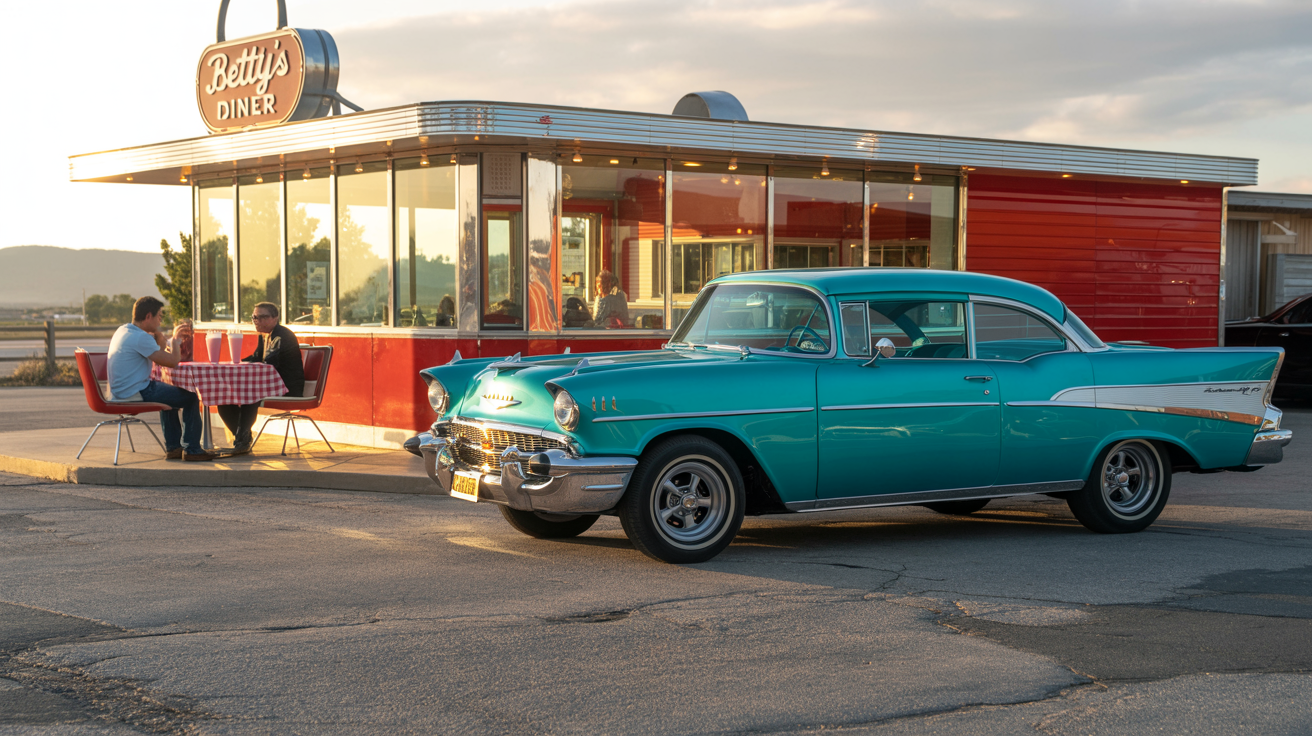
Penny Rodriguez hung her apron on the hook for what would be the last time tomorrow. Forty years of coffee stains had created a kind of abstract art on the pink fabric—a map of rushed mornings and long nights at Crossroads Diner.
“You sure about this?” Ben asked from the grill, where he'd been flipping burgers for the past fifteen years.
“My feet are sure,” Penny laughed, though her heart twisted. “Besides, it's time. Forty years is enough coffee for anyone to pour.”
Word had gotten out, the way word does along Highway 50. Penny was retiring. Moving to Phoenix to be closer to her grandkids. Tomorrow, June 10th, would be her last shift.
What Penny didn't expect was the parade that started at 6 AM.
First came Dr. Elizabeth Smith, who lived two hours away in Sacramento now. Penny blinked twice, certain she was seeing things.
“Elizabeth? Honey, what are you doing here?”
The polished woman in the designer suit was a far cry from the exhausted pre-med student who used to study at table six. “You don't remember, do you? Twenty-two years ago. I was ready to quit medical school. Calculus was killing me, organic chemistry was worse, and I sat right there,” she pointed to the corner booth, “crying into my coffee at 2 AM.”
Penny was already shaking her head. “I remember. You had that big textbook—”
“And you sat down with me. Told me about your daughter Rosa, how she struggled with math too. You said, ‘Mija, the only way to fail is to stop trying.' Then you brought me pie—on the house—and made me promise to come back and tell you when I graduated.”
“And you did,” Penny smiled, remembering. “You brought your diploma.”
“I brought more than that today.” Elizabeth reached into her bag and pulled out a photo album. “Every patient I've saved, every life I've touched—it started with your pie and kindness. My residency program has a scholarship now. It's called the Penny Rodriguez Fund for students who just need someone to believe in them.”
Before Penny could process this, the bell chimed again. A man with salt-and-pepper hair entered, wearing an expensive suit but carrying himself like someone who remembered being hungry.
“Tommy Garrison?” Penny gasped.
“Hi, Miss Penny.” His voice was still soft, like the sixteen-year-old runaway who'd shown up one winter night with holes in his shoes. “Heard you were retiring.”
“Look at you,” Penny marveled. “Last I heard, you were working construction in Reno.”
“That was ten years ago. I own the company now. Fifteen crews.” He sat at the counter, in the same spot where she used to leave him “accidentally” extra food. “You never called the cops on me, never asked too many questions. Just made sure I ate.”
“You were a kid. Kids need to eat.”
“You did more than feed me. Remember what you used to write on my receipts?”
Penny flushed. She'd written little notes on lots of receipts over the years—motivational quotes, reminders that tomorrow could be better, sometimes just smiley faces.
Tommy pulled out his wallet and carefully extracted a faded receipt. In Penny's handwriting: “You're stronger than you know. Keep going.”
“Kept it all these years,” he said. “Read it every time things got hard. I've got thirty-five kids working for me now who aged out of foster care. I feed them, don't ask too many questions, and sometimes I write notes on their paychecks.”
The bell chimed again. And again. And again.
They came in waves, Penny's people. The lawyer who'd been a single mom studying for the bar exam at table three. The mechanic who'd been going through divorce and found solace in late-night coffee and Penny's listening ear. The principal who'd been a troubled teen until Penny convinced him to stay in school.
“Did you call all these people?” Penny asked Ben, who was suspiciously misty-eyed at the grill.
“Didn't have to. That Facebook post went viral—'Last chance to thank the angel of Crossroads Diner.' Reservation list is three pages long.”
By noon, the diner was standing room only. The young couple whose first date Penny had saved by secretly comping their meal when the boy's card was declined—married fifteen years now. The truck driver who'd been drinking himself to death until Penny started “forgetting” to serve him alcohol and talking to him about her own father's struggle. He was five years sober, had his own rig now.
“I don't understand,” Penny kept saying. “I just did my job.”
“No,” said Maria Santos, who'd been eight months pregnant and scared when her car broke down outside. Penny had called her cousin the mechanic, arranged a payment plan, and held Maria's hand through a panic attack. “You did so much more.”
Maria's daughter, now eighteen and headed to college, stepped forward. “I exist because you helped my mom that night. She named me Esperanza—hope—because you gave her that.”
Story after story unfolded. The businessman who'd learned English at the diner, Penny patiently helping him practice while he washed dishes for extra money. The widow who'd found a reason to leave the house in Penny's warm greeting. The veteran who'd been homeless until Penny connected him with her nephew at the VA.
By evening shift, three news crews had shown up. The mayor, who'd been a troubled foster kid eating rage and loneliness until Penny taught him that anger was just fear in work clothes, proclaimed it “Penny Rodriguez Day” in the county.
“This is too much,” Penny protested, overwhelmed. “I need some air.”
She stepped out back, where she'd taken a thousand breaks over forty years. The desert air was crisp, October-cool. She heard footsteps and turned to find a woman she didn't recognize, holding the hand of a young boy.
“You don't know me,” the woman said quietly. “But thirteen years ago, you saved my life.”
Penny waited.
“I was driving to California. Running from an abusive marriage. I stopped here with my son—he was just a baby. I had seventeen dollars to my name and a car running on fumes.” Her voice wavered. “You took one look at me and knew. You fed us, gave me a hundred dollars from your tip jar, and made a phone call to your friend at the women's shelter in Bakersfield.”
“I remember,” Penny said softly. “You were wearing a green sweater. The baby had the hiccups.”
“That baby is this young man.” She nudged the boy forward. “Tell her, David.”
The boy, all gangly limbs and shy smile, held out an envelope. “I wrote my college essay about you. About how one person's kindness can change everything. I got into Stanford.”
Penny's legs gave out. She sat hard on the milk crate she'd used as a break chair for four decades. Tears came then, forty years of small kindnesses reflected back at her in waves.
“I just… I never knew,” she whispered.
The woman sat beside her. “That's the thing about kindness, isn't it? We never see where it goes. It's like dropping pebbles in dark water. You trust the ripples will reach the shore.”
When Penny finally returned inside, the entire diner erupted in applause. Ben had made her favorite—chicken fried steak with extra gravy. The customers had pooled together for a gift.
“We know you're moving to be with family,” Elizabeth Smith announced. “But we wanted to make sure you knew—you already have the biggest family in the world.”
They presented her with a book. Hundreds of pages, thousands of stories. People had been writing in all day, adding their memories, their gratitude, their updates on lives she'd touched without knowing.
“Read it when you doubt that one person can make a difference,” Tommy said.
Penny's last shift ended at midnight. She'd served more hugs than coffee, collected more tears than tips. As she hung up her apron one final time, she found a note pinned to it in Ben's handwriting: “The best servers don't just bring food. They serve hope. Thank you for teaching us all how it's done.”
Two months later, in her Phoenix apartment, Penny got a call from Ben. “You're not going to believe this. Remember that college kid, David? He started something at Stanford—a program where students volunteer at local diners, specifically looking for people who might need extra kindness with their coffee. He calls it the Penny Protocol.”
Penny clutched the phone, looking out at the unfamiliar desert landscape. “The what?”
“The Penny Protocol. His essay went viral. Kids at colleges everywhere are doing it now. Hashtag PennyKindness. You started something, boss. It's spreading.”
After they hung up, Penny opened the book they'd given her, reading a random page. A trucker had written: “You taught me that everyone has a story worth hearing. Now I carry extra cash to help stranded motorists. Paying it forward, one highway at a time.”
She closed the book and smiled. Forty years of pouring coffee. Who knew she'd really been pouring something else entirely—little doses of hope, one cup at a time, creating ripples that had no end.
Her granddaughter called from the next room: “Grandma Penny, can you tell me again about the diner?”
“Come here, mija,” Penny said, opening the book. “Let me tell you about how small kindnesses can change the world.”
