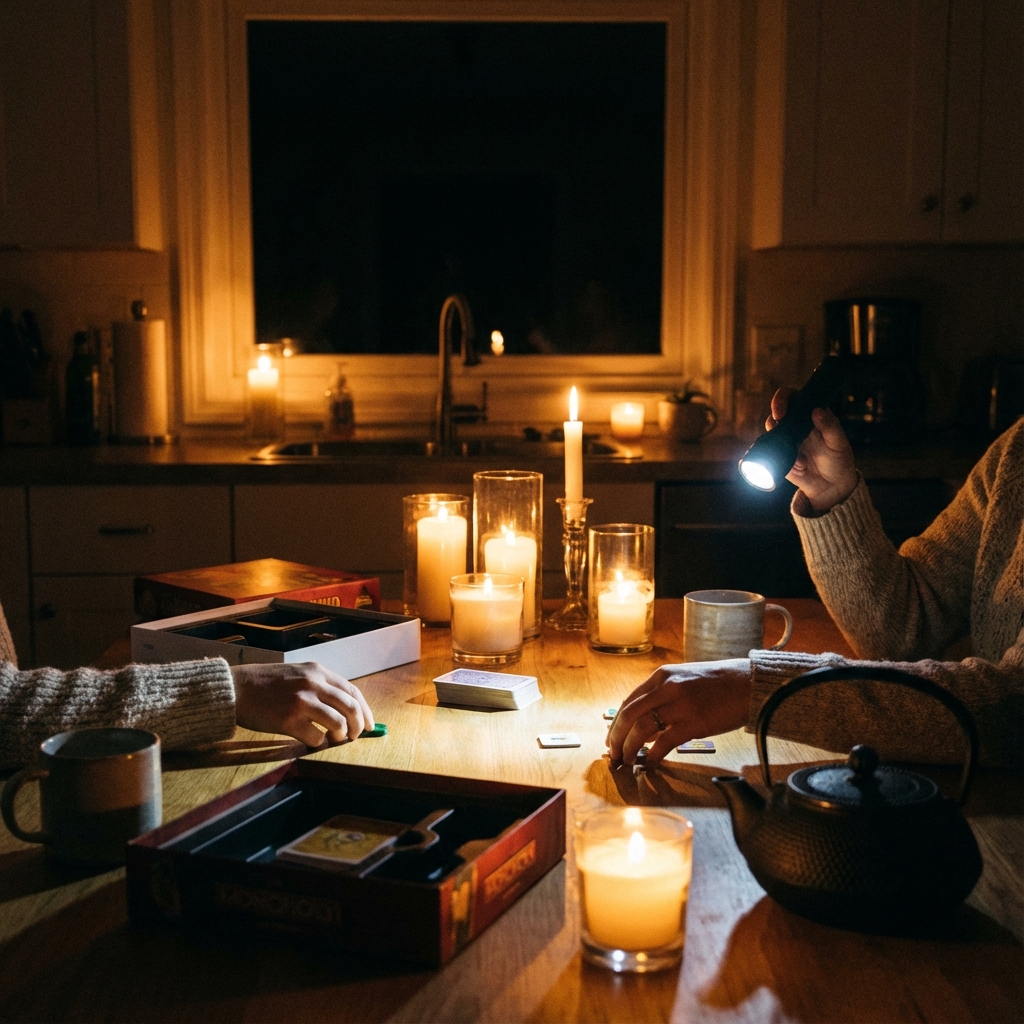
The lights went out at 7:43 PM on a Tuesday in January.
Mira was in the middle of an email, (a very important email, according to her boss, though they were all very important according to her boss) when her laptop screen went black. The lamp on her desk followed, then the hum of the refrigerator in the next room went silent.
She sat in sudden darkness, her eyes adjusting to the faint glow of the streetlights outside. Except the streetlights were out too.
Through the window, she watched the entire block blink into shadow. House by house, the warm rectangles of light disappeared until the whole street was wrapped in winter darkness.
Mira found a flashlight in her junk drawer (dead batteries, of course) and a jar candle left over from Christmas (vanilla, the scent of all seasonal clearance sales). She lit it and sat on her couch, watching the flame flicker, and realized she had no idea what to do.
She’d lived in this house for three years. Three years, and she didn’t know her neighbors’ names.
The people on her left had a yappy dog. The couple across the street argued sometimes, their voices carrying on summer nights when the windows were open. Next door, an elderly woman received grocery deliveries every Thursday, the driver carrying bags up her porch steps while she waited in the doorway.
But names? Life stories? Not a single one.
A knock at the door made her jump.
She opened it to find a man bundled in a puffy jacket, a lantern in his hand and a sheepish expression on his face.
“Hi,” he said. “I’m David, from number 12. I know we’ve never officially met, but my wife had an idea. We’ve got a wood-burning fireplace and some hot chocolate, and she thought maybe the neighbors might want to gather while we wait for the power to come back? No pressure, but…” He gestured at the dark street. “It’s going to be a long cold night otherwise.”
Mira hesitated. She had work to do. Emails to send. Shows to binge, once the power returned.
But her house was already getting cold, and the candle was almost too small to see by, and there was something in David’s expression that made her say yes.
Number 12 was already filling up when she arrived. The woman with the yappy dog was there (the dog was actually quite sweet when you pet it). The arguing couple from across the street turned out to be newlyweds who were still figuring each other out. The elderly woman, whose name was Dolores, had brought homemade shortbread from her freezer.
“It’ll thaw by the time we eat it,” she said practically.
They gathered in David and Rosa’s living room, a mismatched collection of neighbors who’d waved but never spoken, passed on the sidewalk but never stopped. The fire crackled. The hot chocolate was too sweet. Dolores’s shortbread was still partially frozen but perfect anyway.
And they talked.
Mira learned that David was a pediatric nurse and Rosa taught high school biology. That the newlyweds, Steven and Jenna, had met at a laundromat and still bickered about whose turn it was to do the wash. That the woman with the dog (Carol, the dog’s name was Biscuit) had recently lost her husband and adopted the dog so she’d have a reason to go outside every day.
“Grief will keep you in bed if you let it,” Carol said matter-of-factly. “Biscuit doesn’t allow that.”
Dolores, it turned out, had lived on the street for forty-seven years. She remembered when the houses were new, when the trees were saplings, when the neighborhood threw block parties every Fourth of July.
“We stopped doing that sometime in the nineties,” she said wistfully. “Everyone got busy. TVs got bigger. We all retreated indoors.”
“Maybe we could start again,” Rosa said quietly.
No one answered, but Mira saw heads nodding in the firelight.
The power came back at 11:22 PM, a sudden hum of appliances, porch lights flickering on up and down the street. Everyone groaned at the brightness, their eyes adjusted to candlelight.
“Well,” David said, stretching. “Guess the party’s over.”
But no one moved to leave. Not right away.
“Thank you for this,” Mira said, surprising herself. “I’ve lived here three years and this is the first time I’ve felt like I actually belong on this street.”
Carol reached over and patted her hand. “We’ve all been hiding in plain sight, dear. Sometimes it takes the lights going out to help us see each other.”
They exchanged phone numbers before leaving. Rosa started a group text for the block. Steven volunteered to shovel Dolores’s driveway when the next snow came.
As Mira walked back to her house, her porch light blazing, she looked up and down the street. All the houses were lit again, their windows glowing warmly. But now she could see through them differently. Not just houses, but homes. Not just strangers, but neighbors. Not just a street, but a community, fragile, maybe, but starting to take root.
The next morning, she made a batch of muffins and left them on Carol’s doorstep with a note: Thanks for introducing me to Biscuit. Let’s walk together sometime.
Her phone buzzed five minutes later: Tomorrow morning? 7 AM? Biscuit will be thrilled.
Mira smiled, sent back a thumbs-up, and felt, for the first time in a long time, like she was exactly where she was supposed to be.
February 16, 2026
