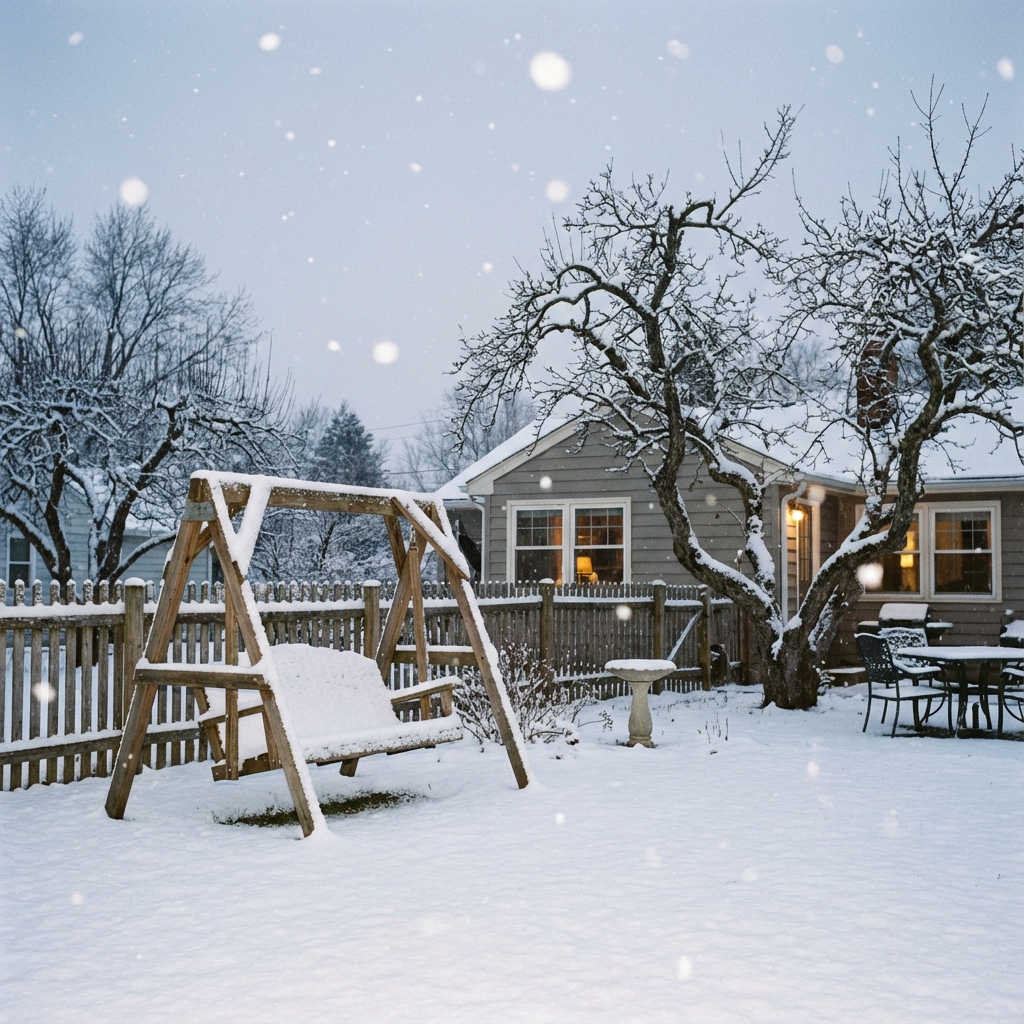
Amara had never seen snow.
In Lagos, where she’d spent her first twelve years, the closest thing to winter was the dry season — cooler evenings, dusty harmattan winds, but never anything falling from the sky except rain.
Her mother had described it, of course. Had shown her pictures how magical it could be. But pictures couldn’t capture the feeling.
“This winter,” her mother promised. “When we move to Minnesota, you’ll see.”
Now it was December, and Amara was waiting.
*
The sky turned gray on a Saturday morning.
Amara pressed her face to the window, watching, holding her breath. Behind her, her mother was making breakfast, the smell of eggs and plantains filling their small apartment.
“Is it coming?” Amara asked.
“You’ll know when it does.”
Amara didn’t look away. She’d been watching all week, through homework and dinner and the too-long hours of night.
And then — a flake.
Just one, drifting past the window like a lost feather. Amara wasn’t sure if she’d imagined it.
Then another. And another.
“Mama!” she shouted. “MAMA, IT’S SNOWING!”
Her mother was at the window in an instant, warm arms wrapping around her daughter. They watched together as the sky opened and the snow began to fall in earnest — millions of tiny crystals tumbling down, covering the parking lot, the cars, the bare trees.
“It’s beautiful,” Amara whispered. “It’s more beautiful than I thought.”
*
She was outside in five minutes, bundled in the puffy coat her mother had bought at a thrift store, boots that came halfway up her shins, mittens that made her hands feel like clumsy paws.
The cold was shocking. She’d never felt anything like it — air that stung her cheeks, made her breath visible, turned the world strange and bright.
But the snow. The snow was magic.
It landed on her sleeve and she stared at it: tiny crystals, each one different, each one perfect. It caught in her hair, dusted her eyelashes, covered everything in soft white silence.
“Catch it on your tongue!” called a boy from the building next door. He was older, maybe fourteen, and he was making a snowball.
Amara tipped her head back, opened her mouth, and waited. A flake landed — cold, melting instantly.
“It tastes like nothing,” she said, disappointed.
“It tastes like winter,” the boy corrected. “That’s a real thing. You’ll see.”
*
By afternoon, the parking lot was transformed.
Kids Amara didn’t know appeared from every building, stomping through the accumulating snow, throwing it at each other, rolling it into balls and then boulders. The boy from next door — his name was David— showed her how to pack a proper snowball: tight enough to hold its shape, loose enough not to hurt.
“You’re a natural,” he said, after she hit his shoulder on her third throw.
“I’m from Lagos,” she said. “I’ve never seen snow before.”
David’s eyes went wide. “Never? Like, ever?”
“Never. This is my first time.”
He considered this. Then: “We should do something special. Build something.”
*
They built a snowman.
It took two hours, three other kids, and more strength than Amara had expected. Snow was heavy. But by the time the sun started setting, they had a lumpy figure standing in the center of the parking lot, with rocks for eyes and a stick for a nose.
“Needs a scarf,” David decided.
Amara ran inside. She came back with a bright orange scarf — her favorite, the one she’d brought from her first home.
“Are you sure?” David asked. “It’ll get wet.”
“It’s worth it.”
She wrapped the scarf around the snowman’s neck and stepped back. It looked perfect. Imperfect and perfect, all at once.
Her mother appeared at the window, took a photo, and gave her a thumbs-up.
*
That night, Amara pressed her face to the window again.
The snow had stopped, but the world was still covered. Streetlights made everything sparkle. The snowman stood guard in the parking lot, wearing her orange scarf.
“How do you feel?” her mother asked.
Amara considered. She felt cold, tired, happy. She felt like something important had happened.
“Like I’m really here now,” she said. “Like this is home.”
Her mother kissed the top of her head. “It is home. It just took a while for it to snow.”
*
The snowman lasted three days before the temperature rose and it melted into nothing. Amara retrieved the soggy scarf, washed it, and hung it to dry.
She’d build another one next time, she decided. And the time after that. Every year, as long as she lived here, she’d build something in the snow.
Because now she understood what the boy David had meant. Winter tasted like something. It tasted like new beginnings, new friendships, new chances.
It tasted like home, finally found.
