“You want me to join your quilting group?”
Lily stared at her grandmother like she’d suggested joining a circus. Grandma Ruth just smiled, that serene expression she wore when she knew she was right about something and was waiting for everyone else to catch up.
“It’s just for the summer,” Ruth said. “You’re living with me anyway while your apartment is being renovated. Might as well try something new.”
“Grandma, I’m twenty-eight. I work in tech. I don’t… quilt.”
“Neither did I, until I was sixty-two. Now I can’t imagine my life without it.” Ruth patted Lily’s hand. “Just come to one meeting. If you hate it, you never have to come back.”
Lily sighed. Her grandmother had a way of making requests that were actually commands, wrapped in so much warmth that you couldn’t possibly refuse.
“One meeting,” she agreed.
The Stitches of Time Quilting Circle met every Thursday evening in the basement of the local Church. Lily walked in expecting doilies and dusty silence.
What she found was controlled chaos.
Seven women ranging from sixty to ninety were crowded around a large table, fabric scraps spreading across every surface like a textile explosion. Someone had brought wine. Someone else had brought a portable speaker playing what Lily was fairly certain was Fleetwood Mac. The noise level suggested a party more than a craft session.
“Everyone, this is my granddaughter Lily,” Ruth announced. “She’s going to learn to quilt this summer.”
“Oh, how wonderful!” A tiny woman with enormous glasses clasped Lily’s hands. “I’m Mabel. Ruth talks about you all the time. Something about computers?”
“I’m a software engineer,” Lily said.
“How marvelous. I don’t understand any of that.” Mabel beamed at her. “Come sit by me. I’ll teach you to cut fabric without losing a finger.”
Over the next two hours, Lily learned several things:
First, quilting was harder than it looked. Her cuts were crooked, her stitches uneven, and she somehow managed to stab herself with a needle four times despite allegedly being good with her hands.
Second, these women were not the sweet elderly ladies she’d imagined. Mabel told a story about her third husband that made Lily choke on her wine. A woman named Doris had opinions about local politics that could peel paint. And Ruth’s best friend, Pearl, had apparently once been arrested at a protest in the 1970s and still had the mug shot framed in her bathroom.
Third, and most surprisingly: Lily was having fun.
By the end of the evening, she’d produced something that vaguely resembled a quilted square, if you squinted and were very generous. Pearl proclaimed it “charmingly rustic.” Ruth just smiled and said, “See you next week?”
Lily found herself nodding.
The summer unfolded in squares of fabric and hours of conversation.
Lily learned to piece together patterns, matching colors and shapes in ways that required a different kind of logic than coding but felt strangely similar. She learned the names of stitches and the history of quilts, how they’d been used to send secret messages, to commemorate births and deaths, to wrap babies and bury the beloved.
But mostly, she learned about the women.
Mabel had been a nurse in the Korean War. She’d seen things she still didn’t talk about, except sometimes, late in the evening, when her hands were busy and the rhythm of sewing seemed to unlock old memories.
Doris had raised seven children alone after her husband left. She’d started quilting to make blankets she couldn’t afford to buy, and now she made them for the NICU at the local hospital, wrapping premature babies in warmth she wished she’d had.
Pearl had never married, had traveled the world, had lived what sounded like seven different lives. She quilted because it grounded her, she said. Because after all that wandering, it was nice to make something that would stay in one place.
And Ruth, Lily’s grandmother, who she’d always thought she knew, had started quilting after Lily’s grandfather died.
“I needed something to do with my hands,” she explained one evening. “Something that would let me think about him without drowning.”
Lily looked at the quilt her grandmother was working on, recognizing suddenly the pattern: her grandfather’s old flannel shirts, cut into careful squares, being stitched into something new.
“Grandma,” she said softly.
Ruth squeezed her hand. “It’s not sad, sweetheart. It’s a way of keeping him close. Every stitch is a memory.”
At the end of the summer, Lily finished her first quilt.
It was small, a lap blanket, barely big enough to cover her legs. The colors clashed in places, and one corner was definitely a different size than the others. But she’d made every stitch herself, choosing each fabric with care.
“What will you do with it?” Ruth asked, examining the finished product with grandmother-pride.
Lily thought about her apartment, waiting for her to return. Her life back in the city — the long hours, the screens, the efficiency of everything digital and instant.
“I think I’ll keep it,” she said. “To remember this summer.”
“You could also come back,” Ruth suggested lightly. “Thursday nights. The circle continues.”
Lily hesitated. It was a long drive from the city. She had work, responsibilities, a life that didn’t include church basements and Fleetwood Mac and women old enough to be her grandmother.
But she also had something new now: a skill that required slowness, patience, presence. A connection to a group of women who had welcomed her without expectation. A different relationship with Ruth, built not just on family obligation but on shared hours and shared stitches.
“Maybe once a month,” she said. “If that’s okay.”
Ruth’s smile could have lit the room. “I’ll save your seat.”
Three years later, when Ruth passed away peacefully in her sleep, the quilting circle came to the funeral in force.
They sat in the front row, seven women who had lost their eighth but would never lose what she’d given them. Afterward, at the reception, they presented Lily with something wrapped in tissue paper.
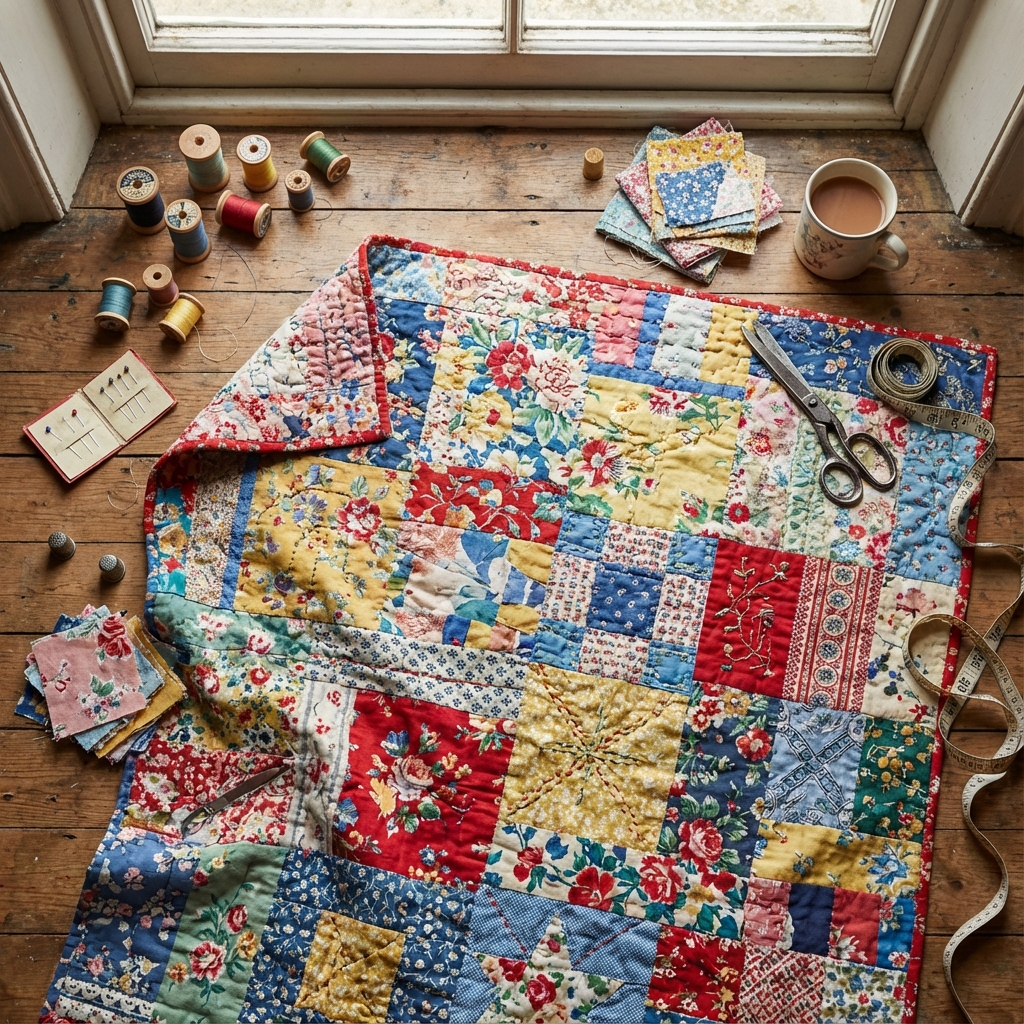
It was a quilt. Made entirely from Ruth’s fabrics, her old dresses, her favorite scarves, a piece of the apron she’d worn every time she baked cookies. Every member of the circle had contributed squares, their stitches intermingled with Ruth’s final project.
“She wanted you to have it,” Pearl said, her voice thick. “She worked on it for two years. Kept saying it was almost done.”
Lily held the quilt to her chest, tears streaming down her face. She could feel her grandmother in every seam, every carefully chosen pattern.
“Thank you,” she whispered. “For everything.”
That night, Lily wrapped herself in the quilt and slept more deeply than she had in months. And on the first Thursday after the funeral, she drove two hours to the church basement, sat in Ruth’s old seat, and picked up where her grandmother had left off.
Some circles weren’t meant to be broken. They just expanded, welcoming new hands, passing along old wisdom, stitching past to present to future, one square at a time.