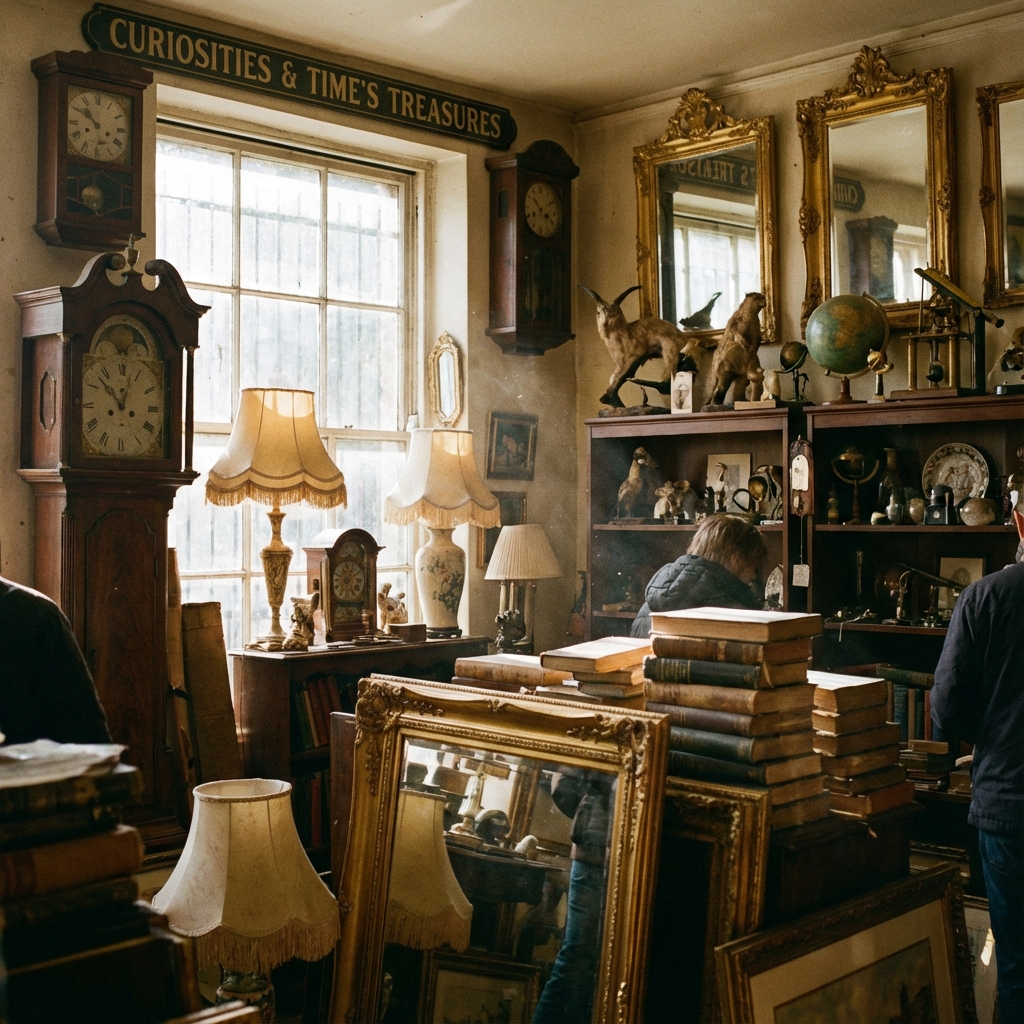
The little bell chimed when Ruth walked in.
She hadn’t meant to stop here — she’d been walking to clear her head after another argument with her daughter. But something in the window caught her eye: a ceramic music box, blue and white, exactly like one her grandmother had owned.
The shop was cluttered in the best way. Furniture and knickknacks piled together, each piece carrying the weight of someone else’s life.
“Looking for something specific?” The owner appeared from behind a grandfather clock — a man in his seventies, reading glasses perched on his nose.
“The music box in the window,” Ruth said. “How much?”
He smiled. “Ah. The dancer. She’s been here three years waiting for the right person. Let me get her.”
*
The music box played “Swan Lake.”
Ruth wound it carefully, watching the tiny ballerina spin on her spring. The melody was slightly tinny, worn from decades of use, but unmistakably familiar.
“My grandmother had one just like this,” she said.
“Many grandmothers did. They were popular in the fifties. But not many survived — too delicate.”
“What happened to hers?”
Ruth hadn’t thought about it in years. “Lost, I think. When she moved to the nursing home. Things got scattered.”
The man nodded like this made sense. “Things have a way of getting lost. And sometimes found again.”
She bought the music box. But she didn’t leave.
Instead, she wandered the aisles, touching old picture frames and tarnished silverware, feeling the energy of objects that had outlived their original owners.
“Who brings these things in?” she asked.
“Estate sales, mostly. Families clearing out houses. Sometimes people just walk in with a box of items they don’t know what to do with.”
“That’s sad.”
“Sometimes. But I prefer to think I’m giving things a second chance. A teacup doesn’t know it’s been abandoned. It just waits for someone to drink from it again.”
*
Ruth started coming back.
At first, just to browse. Then to help — the owner, Victor, was getting too old to organize alone. She’d sort donations, price items, arrange displays.
She wasn’t sure why she kept returning. Maybe because the shop was quiet. Maybe because Victor didn’t ask questions or expect anything. Maybe because, surrounded by other people’s pasts, her own seemed less overwhelming.
Her daughter didn’t understand. “You’re volunteering at a junk shop?”
“It’s not junk,” Ruth said. “It’s history. And I’m not volunteering. I’m… belonging.”
*
One afternoon, a young woman came in with a cardboard box.
“My grandmother passed,” she said, voice tight. “I don’t know what to do with this stuff. I can’t keep it all.”
Victor was out. Ruth took the box gently.
“I’m sorry for your loss,” she said. “May I look?”
Inside: a hairbrush, some jewelry, a stack of letters tied with ribbon. A whole life, condensed into a box.
“We’ll take good care of them,” Ruth promised. “We’ll find the right people.”
The young woman’s eyes shone. “She would have liked that. She hated waste.”
“Then she would have liked this place.”
*
Ruth found herself pairing items with people.
The hairbrush went to a vintage collector who was building a vanity set. The letters went to a historian researching the 1960s. A strand of pearls found a bride-to-be who couldn’t afford new ones.
“You have a gift,” Victor observed.
“For what?”
“Matching. Seeing where things belong.”
Ruth looked around the shop — at the objects waiting, the second chances stacked on every shelf.
“I used to feel like I didn’t belong anywhere,” she admitted. “Maybe I recognize the feeling in things.”
“And now?”
She smiled. “Now I’m where I’m supposed to be.”
*
When Victor retired, he gave her the shop.
“For the past years, it was always more yours than mine,” he said. “I just kept the lights on. You gave it a soul.”
Ruth kept the same little bell, the same cluttered aisles, the same promise: everything deserves a second chance.
And the music box — her grandmother’s, or one just like it — still sat on the counter, still playing “Swan Lake,” still waiting for whoever needed to hear it next.
