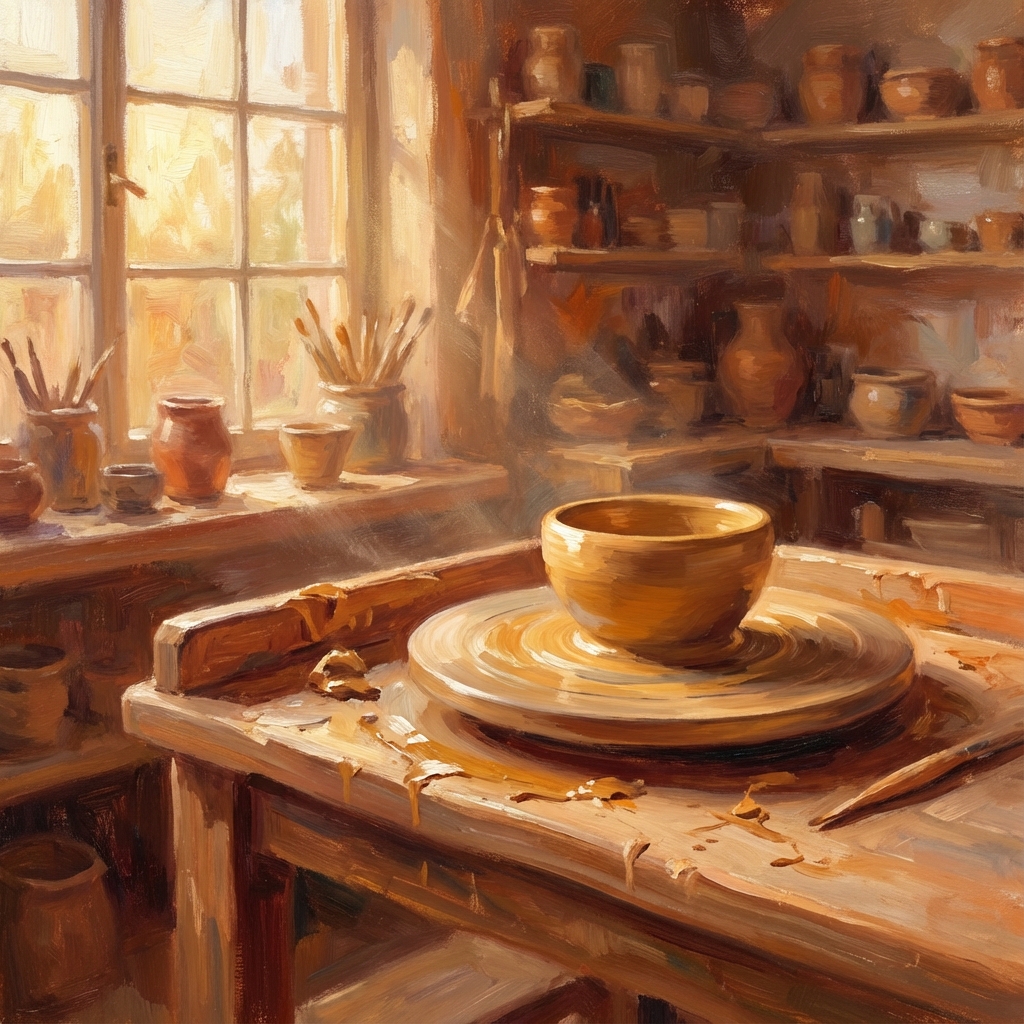
The first bowl Richard made was a disaster.
It started as a cylinder, then became a blob, then collapsed entirely under his unsteady hands. The young instructor — she couldn’t have been older than his granddaughter — smiled encouragingly and said, “That’s totally normal for a first try.”
Richard nodded, embarrassed, and stared at the gray mess on his wheel. He was seventy-three years old, a retired electrician with hands that had wired countless homes, and he couldn’t manage a simple bowl.
But he came back the next week. And the week after that.
It had been Margaret’s idea, actually. Not the pottery — she’d been gone for eight months now, and her ideas had stopped coming the way they used to, in the middle of dinner or on Sunday morning walks. But she’d always said he needed a hobby beyond crosswords and cable news. “Something with your hands,” she’d insist. “You’re good with your hands.”
The pottery studio was three blocks from their apartment — his apartment now — and he’d walked past it a hundred times without really seeing it. Then one gray Tuesday, the door was propped open, and warm light spilled onto the sidewalk, and Richard found himself inside before he’d made a conscious decision to enter.
Six weeks in, his bowls were still wobbly. Lopsided. One memorable attempt had a bottom so thin it cracked in the kiln, leaving what looked like a ceramic donut.
“These are beautiful,” said Elena, the young woman who ran the studio, examining his latest batch.
Richard snorted. “They’re crooked.”
“They’re handmade,” Elena corrected. “There’s a difference. Perfect bowls are boring. These have character.”
She held up one of his pieces — a small bowl glazed in uneven blue, its rim dipping noticeably on one side. “This one especially. It looks like it’s listening.”
Richard didn’t know what to say to that, so he said nothing: But he took the bowl home that night and set it on his kitchen table, where it did look, somehow, like it was leaning in to hear something.
He made more bowls. Then mugs. Then small vases that Margaret would have filled with flowers from the farmer’s market, if Margaret were still here to fill them.
“What do you do with all these?” Elena asked one evening, as Richard loaded another batch into the kiln.
“Nothing, really. They just… accumulate.”
Elena was quiet for a moment. Then: “There’s a women’s shelter two blocks over. They’re always looking for donations — dishes, mugs, things that make a temporary space feel more like home. Would you want me to ask if they’d take some?”
Richard considered this. His apartment was already full of Margaret’s things — her books, her photographs, her collection of ceramic birds that he couldn’t bring himself to move. Adding his own imperfect creations to the clutter seemed absurd.
“Sure,” he said. “Why not.”
The following week, Elena reported back. The shelter had been delighted. The crooked bowls, the lopsided mugs — the women there loved them. One resident had apparently claimed the blue “listening” bowl for her bedside table. Said it made her feel less alone.
Something shifted in Richard after that.
He started coming to the studio four days a week instead of two. He experimented with glazes — deep greens, sunset oranges, a purple that reminded him of Margaret’s favorite scarf. He made bowls for cereal and bowls for soup, mugs with handles sized for small hands and large ones for people who needed a lot of coffee.
Each piece was imperfect. Each piece was intentional. He began to see the wobbles not as failures but as signatures — proof that a human hand had shaped this thing, that someone had cared enough to try.
The shelter started requesting specific items. Could he make something in yellow? One of the children was having a birthday. Could he try a set of matching bowls? A family was moving into their own apartment for the first time in two years.
Richard made them all. He discovered he was good with glazes — good at mixing colors that felt warm, that felt like comfort. He learned to leave small imperfections on purpose: a thumbprint in the handle, a slight unevenness in the rim. Elena called it “wabi-sabi.” Richard called it “character.”
One evening, as he was locking up his wheel for the night, Elena handed him an envelope.
“This came for you,” she said. “From the shelter.”
Inside was a card, signed by a dozen names in different handwriting. Some neat, some scrawled, one in purple crayon.
Thank you for the bowls, it read. They make us feel like we matter. Like someone made something just for us.
Richard read it three times, standing there in the cooling studio.
He thought about Margaret, who had spent thirty years as a hospital volunteer, who had believed that small kindnesses were never small. He thought about his hands, which had built and fixed and connected things for decades, and which had been so lost after she died — clutching at crossword puzzles, flipping channels, closing around nothing.
Now they were covered in clay dust, and he had somewhere to be four days a week, and somewhere out there, a child was eating cereal from a purple bowl he’d made, and a woman was keeping her rings in a lopsided dish by her bed.
The bowls were still crooked. They would always be crooked.
But they held things beautifully.