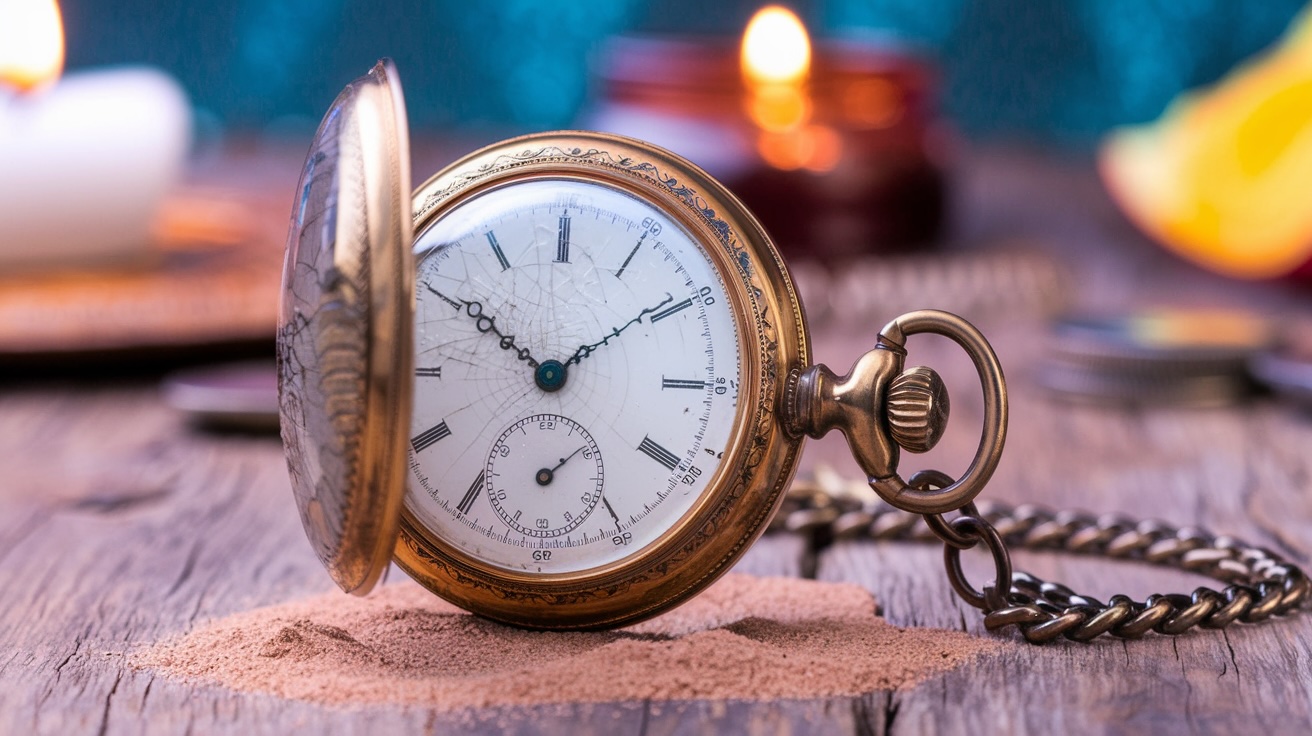
Sarah Bennett kept her grandmother's broken watch in her locker at St. Mary's Hospital, tucked between her spare scrubs and the peppermints she used to stay alert during night shifts. The watch face was cracked, its hands frozen at 11:47, and it hadn't ticked once in the fifteen years since Grandma Rose died.
“It will work when you need it most,” the note had said, written in her grandmother's careful script. “Trust in time's perfect wisdom.”
Sarah had almost thrown it away a dozen times. She was a nurse, a woman of science. She believed in blood pressure readings and medication schedules, not mystical timepieces. But something always stopped her, maybe just the weight of it in her hand, solid and real like her grandmother's love had been.
Tonight felt different from the moment she clocked in. The storm outside was fierce, rattling windows and making the lights flicker. The night shift crew exchanged nervous jokes about horror movie weather.
“At least we have the backup generators,” Eric said, checking the emergency supplies for the third time. He was new, still jumpy about overnight shifts in the cardiac unit.
“Hospitals don't lose power,” Sarah assured him, though she found herself touching her locker, thinking of the watch. “Too many redundancies.”
At 11:15, she was shown wrong.
The lights died with a definitive thunk. The familiar hum of machines stopped. For one heart-stopping second, the cardiac unit was silent. Then the chaos began, monitors beeping on battery power, nurses calling out status reports, the emergency lighting casting everything in harsh shadows.
“Generators aren't kicking in!” Dr. Rinieri shouted. “Something's wrong with the automatic transfer switch.”
Sarah's mind went into crisis mode, mental calculations running. Battery backups would last thirty minutes, maybe forty. The ventilators had their own power supplies, but the medication pumps, the warming units for the premature babies one floor up…
“Room 314,” Eric called, panic edging his voice. “Mr. Torres, post-op cardiac surgery. His pump's alarming. Battery's showing five percent.”
Sarah ran. Mr. Torres was three days post triple bypass, dependent on the intravenous medication keeping his heart rhythm stable. Without it…
She burst into the room, flashlight beam cutting through darkness. Miguel Torres, age 42, father of three. His wife Maria stood by the bed, clutching his hand.
“What's happening?” Maria's voice was small, scared.
“Power outage. We're handling it.” Sarah checked the pump, three minutes of battery left, maybe four. The medication couldn't be interrupted. Manual administration was possible but required precise timing. In the dark, reading the drip rate would be nearly impossible.
“I need more light,” she told Eric. “Every flashlight you can find.”
But she knew it wouldn't be enough. The IV pump's display was too small, the graduated markings on the manual drip chamber too fine. She needed steady light, both hands free, and perfect timing.
Strangely, her grandmother's voice echoed in her memory: “It will work when you need it most.”
Sarah ran to her locker, hands shaking as she spun the combination. The watch sat there, unchanged, frozen at 11:47. She grabbed it anyway, desperate for any talisman.
Back in room 314, the pump gave its final beep and died.
“Starting manual administration,” Sarah announced, her voice steadier than her hands. She hung the IV bag on the pole, attached the manual drip chamber, and began counting drops in the flashlight's wavering beam. Too fast would overload his heart. Too slow would let arrhythmia set in.
“Fifteen drops per minute,” she muttered. “Four-second intervals.”
But counting seconds in her head while monitoring drops was impossible. The darkness pressed in. Maria's quiet prayers filled the silence. Eric held two flashlights, but the shadows danced, making it hard to see.
Sarah glanced at her grandmother's watch, ready to use it just to have something solid to grip. The face was dark, hands still frozen.
Then she saw it. A faint glow, barely visible. The watch's radium-painted numbers and hands were glowing—not bright, but steady. Consistent. Enough.
“Eric, turn off the flashlights.”
“What? Sarah, no—”
“Trust me. Off.”
Darkness engulfed them. And in that darkness, the watch face bloomed with ghostly light. The radium paint, charged by years of sitting under fluorescent lights, released its stored energy in a gentle, unwavering glow.
Sarah held the watch next to the drip chamber. The luminous hands gave her a fixed point of reference, the glowing second marks letting her time the drops precisely. Four seconds. Drop. Four seconds. Drop.
“How are you doing that?” Eric whispered.
“Old watch. Radium paint.” She didn't mention that radium paint shouldn't glow this brightly after fifty years. Didn't mention that the light seemed to pulse with her heartbeat, steady and sure.
Fifteen minutes passed. Twenty. Sarah's world narrowed to the rhythm, watch, drops, breath. Mr. Torres's heart rate stayed stable. The watch's glow never wavered.
At 11:47, exactly thirty-two minutes after the power died, the lights blazed back on. Machines hummed to life. The IV pump resumed with a cheerful beep, exactly in sync with Sarah's manual drip rate.
“Dios mío,” Maria breathed. “You saved him. In the dark, you saved him.”
Sarah looked at the watch. Its glow was fading now, unnecessary in the fluorescent brightness. But for just a moment, she could swear the second hand ticked. Just once. A tiny movement at exactly 11:47.
Dr. Rinieri arrived, checking readouts. “Textbook medication continuity. Sarah, how did you maintain precise timing in the dark?”
She held up the watch. “My grandmother's. The radium paint still glows.”
He examined it with professional interest. “Remarkable preservation. Though radium paint degrades significantly after…” He paused, peering closer. “This shouldn't be possible. The luminosity level after this many years…”
“Sometimes we get lucky,” Sarah said simply.
The rest of the shift passed in debriefs and documentation. They learned a freak lightning strike had damaged both the main power and the generator transfer system, a million-to-one chance. Maintenance was already implementing new safeguards.
At 7 AM, Sarah returned to her locker. The watch sat innocently on the shelf, looking exactly as it had for fifteen years, cracked face, frozen hands, an antique too broken to tell time.
But now she understood. Her grandmother had been a night nurse too, back when radium-painted watches were standard issue. How many dark nights had this watch seen? How many moments when time mattered most?
She found Eric before leaving. “You did well tonight. Stayed calm.”
“I was terrified,” he admitted. “But watching you with that watch, so focused… it reminded me why we do this. Those moments when everything depends on us.”
Sarah nodded. “My grandmother used to say nursing wasn't about the big saves. It was about being present in the small moments when presence matters most.”
“Smart woman.”
“She was.” Sarah touched her pocket where the watch rested. “She really was.”
The next day, Sarah visited her grandmother's grave for the first time in months. She brought flowers, and the watch.
“Thank you,” she said simply. “For knowing I'd need it. For knowing when.”
She'd had the watch examined discretely. The radium paint was indeed degraded beyond function. It shouldn't have glowed. Certainly not that brightly, that steadily, for that long.
But it had.
Sarah kept the watch in her locker still, a reminder that some things transcended explanation. That sometimes what we need isn't advanced technology or modern solutions, but the simple gift of light in darkness, of time when time matters most.
And sometimes, late in her shift when the hospital quieted and the darkness pressed against the windows, she'd hold the watch and feel her grandmother's presence, a steady glow across the years, promising that help comes in many forms, often when we need it most.
The watch never glowed again. It didn't need to. Its moment had come at exactly the right time, 11:47 on a storm-struck night when love reached across death itself to guide steady hands and save a life.
In the end, Sarah thought, that's what the best promises do. They wait, patient and sure, for the perfect moment to be kept.