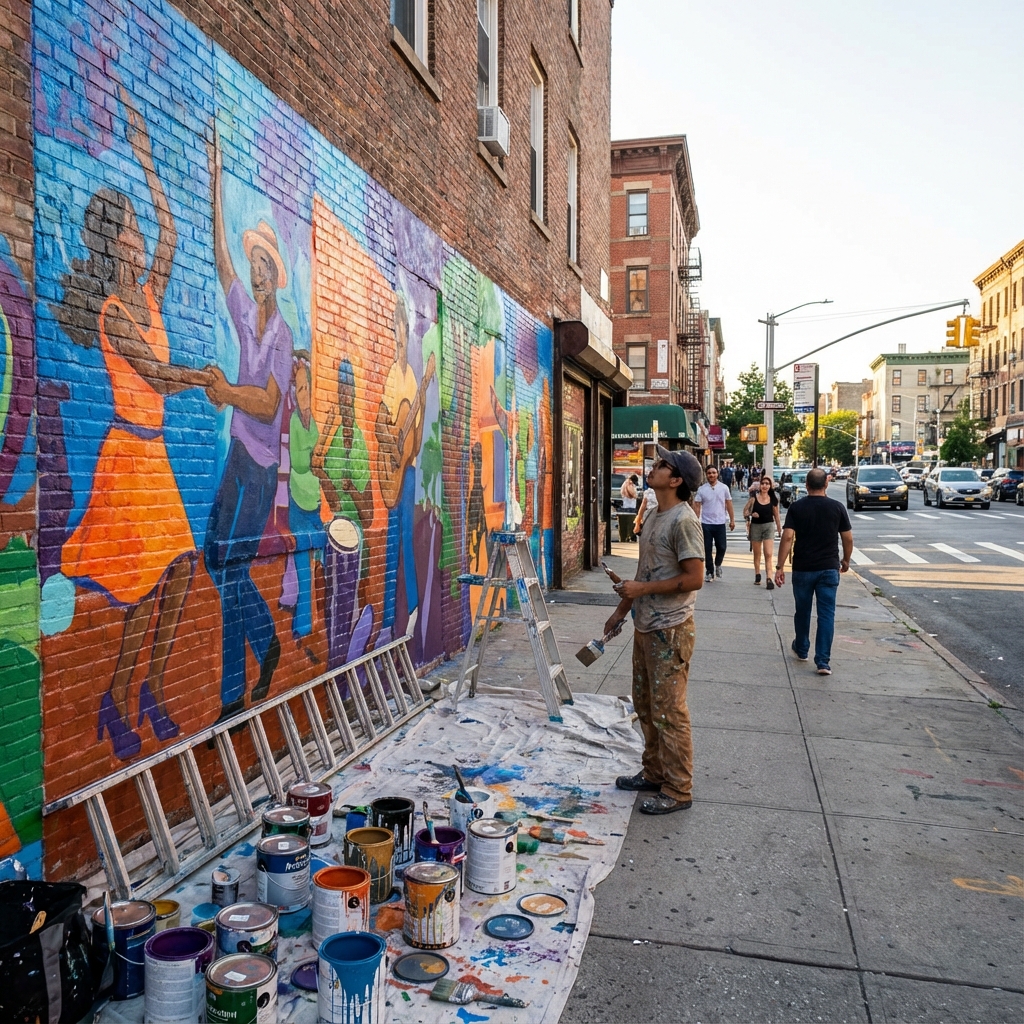
The wall had been ugly for as long as anyone could remember.
It ran along the back of the abandoned hardware store on Maple Street, a stretch of concrete that had once been painted white but had faded over the decades into a grimy gray, decorated only by halfhearted graffiti tags and water stains that looked vaguely like sad faces.
Nobody looked at it. Nobody cared. It was just part of the landscape, like cracked sidewalks and overflowing trash cans , urban furniture that everyone had stopped seeing long ago.
Then Rosa Martinez moved into the apartment above the laundromat, and she decided the wall was a canvas.
“You’re going to do what?” asked David, who ran the dry cleaner next door, when Rosa approached him with her idea.
“Paint it. The whole thing. A mural.” Rosa’s eyes were bright with the particular intensity of someone who had already made up her mind. “The neighborhood could use some color, don’t you think?”
David looked at the wall. He’d walked past it every day for twenty years and couldn’t remember the last time he’d actually noticed it. “I suppose it couldn’t get worse.”
Rosa smiled. “That’s the spirit.”
Getting permission took two weeks and seventeen phone calls to various city departments. Getting paint took a month of fundraising — bake sales, a GoFundMe, and a surprisingly generous donation from the owner of the abandoned hardware store, who turned out to be a retired art teacher living in Florida.
Getting volunteers, Rosa assumed, would be the hardest part.
She was wrong.
The first to show up was Daniel, the teenager from apartment 4C who dressed in all black and had never spoken to anyone in the building. He appeared at the wall the first Saturday morning with a skateboard under one arm.
“My mom said I had to do something ‘constructive’ this summer,” he muttered. “This counts, right?”
“Absolutely,” Rosa said, handing him a brush.
Daniel, it turned out, could draw. Not flowers or landscapes, but intricate geometric patterns that seemed to pulse with hidden energy. Rosa gave him an entire corner of the wall and watched as something remarkable emerged , sharp angles softened by curves, colors bleeding into each other like a sunset through prisms.
Next came the Nguyen family — parents, grandparents, three kids ranging from four to fourteen. The youngest wanted to paint butterflies. The oldest wanted to paint her favorite anime character. The grandmother wanted to paint lotus flowers. Rosa found room for all of it.
The dry cleaner, David, returned with his wife, who had been a calligrapher. She spent three days painting a single phrase in flowing characters across the top of the wall: A thousand hands, one home.
Word spread. By the third weekend, Rosa had more volunteers than wall space.
The retired mail carrier painted birds, dozens of them, each one different, migrating across the concrete sky. The librarian added books, open and flying like the birds, their pages spilling words that became flowers became stars became more birds.
A little girl who couldn’t reach higher than three feet painted a row of houses along the bottom. Wonky rectangles with triangular roofs, each one a different color. When Rosa asked what they were, she said, “That’s our street. See? That’s your building. That’s the grocery store. That’s my house.”
It didn’t look anything like their street. It looked better.
The mural took six weeks to complete.
On the final day, they added the last element: handprints. Every person who had contributed pressed their palm into paint and left their mark somewhere on the wall. Hands of all sizes, all colors, overlapping and adjacent, a constellation of human connection.
Rosa stood back and looked at what they’d made.
It was chaotic. The styles didn’t match. The proportions were off. One section was clearly painted by a professional artist, and the next was clearly painted by a four-year-old who had decided trees should be purple.
It was beautiful.
“This is something else,” said David, appearing beside her with two cups of coffee. He handed her one. “I’ve lived here twenty years and never talked to half these people. Now I know their names, their kids’ names, what they like on their pizza.”
“Paint does that,” Rosa said. “Forces you to stand next to someone for hours. Hard not to talk.”
“Is that why you did it? To make us talk to each other?”
Rosa considered the question. She’d moved here after her divorce, knowing no one, feeling invisible in a way that was both relief and ache. The wall had been an excuse, maybe. A reason to knock on doors. A project that required more hands than just hers.
“I did it because the wall was ugly,” she said finally. “But I think I needed something too. Maybe we all did.”
***
A year later, the mural had become a local landmark.
Tour groups stopped to take photos. The city featured it in a “hidden gems” walking guide. Someone made a TikTok that got half a million views, prompting a minor tourism spike that briefly overwhelmed the coffee shop on the corner.
But Rosa’s favorite moment happened on a quiet Tuesday afternoon, when she walked past and found Daniel — no longer dressed in all black, now applying to art school — touching up a corner of his geometric pattern.
Beside him stood a girl Rosa didn’t recognize, watching with wide eyes.
“Can I add something?” the girl asked. “I just moved here.”
Daniel looked at Rosa, who had appeared at his shoulder. She nodded.
“Yeah,” Daniel said, handing the girl a brush. “Find a spot. There’s always room.”
The girl smiled, and Rosa watched as she added a tiny orange cat to the corner of the mural, curled between Daniel’s angles and David’s wife’s calligraphy.
A thousand hands, one home.
The wall was never finished. That was the whole point.