Amanda had been staring at the departures board for forty minutes when the announcement came: her flight was delayed another three hours.
She sighed, adding it to the list. Delayed flight. Lost luggage last week. Failed project at work. Relationship that had ended not with a bang but with a slow, exhausting fade. Somewhere along the way, her life had become a series of waiting rooms, and she couldn’t remember what she’d been waiting for.
She wandered away from her gate, looking for coffee, a distraction, anything to fill the time. That’s when she saw it.
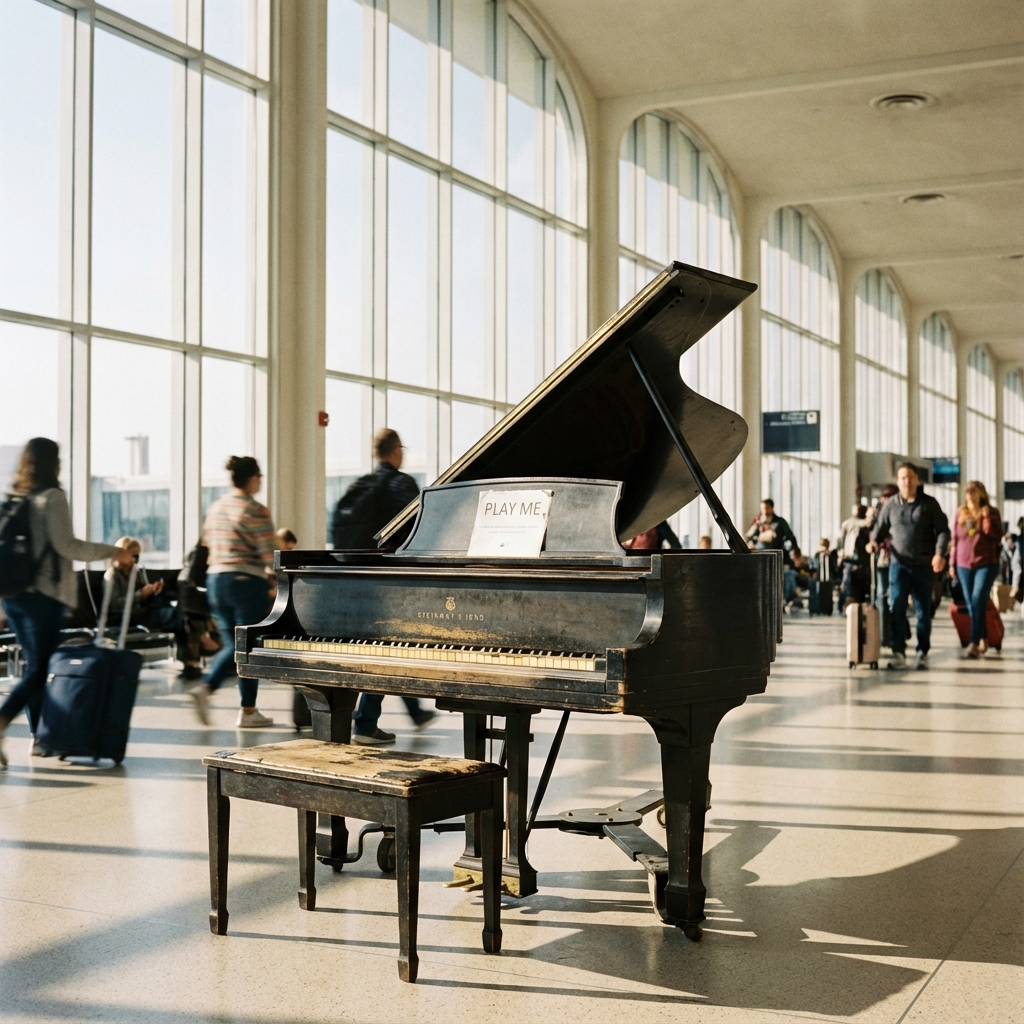
A piano. An old upright, slightly scuffed, sitting in a corner of the terminal near a cluster of potted plants. A small sign above it read: “Play Me.”
Amanda stopped short.
She hadn’t touched a piano in twelve years. Not since she’d abandoned her music degree halfway through junior year, convinced by a well-meaning advisor that she should pursue something “practical.” She’d gotten an accounting degree instead, then a job, then a cubicle, then a life that paid the bills but rarely made her heart race.
The piano sat there, waiting, its keys slightly yellowed under the fluorescent lights.
Don’t be ridiculous, she told herself. You’re rusty. You’ll embarrass yourself.
But her feet carried her forward anyway, and before she could talk herself out of it, she was sitting on the worn bench, her carry-on bag at her feet.
She touched a single key. Middle C. The note rang out, clear and true, slicing through the ambient noise of the terminal. It sounded like a door opening.
Amanda’s fingers found the opening notes of Debussy’s “Clair de Lune” — the piece she’d played for her college audition, a lifetime ago. She’d made two mistakes that day, she remembered. The panel had smiled politely and told her she had potential but needed to relax.
She made three mistakes now. Then four. Her hands wouldn’t cooperate, the music fighting through years of neglect. She considered stopping, slinking away before anyone noticed.
Then a small voice said, “That’s pretty.”
Amanda looked up to find a girl, maybe seven or eight, watching her with wide eyes. Behind her, a tired-looking mother offered an apologetic smile.
“Sorry,” the mother said. “She just ran over. We’ll leave you alone.”
“No, it’s okay.” Amanda turned back to the keys. “I’m just… practicing. I’m not very good anymore.”
“I liked it,” the girl said firmly. “It sounds like water.”
Amanda smiled, something warm stirring in her chest. “It’s supposed to. It’s called ‘Clair de Lune.’ It means moonlight.”
“Play more?”
So Amanda did. She started from the beginning, slower this time, letting the music breathe. The mistakes smoothed out — not all of them, but enough. The piece emerged from her memory like a photograph developing, blurry at first, then sharpening into focus.
She became aware of others gathering. A businessman had paused mid-email. A couple with matching backpacks leaned against a pillar, listening. An elderly man in a veteran’s cap sat down on a nearby bench and closed his eyes.
Amanda kept playing.
When she finished, there was a moment of silence. Then the little girl clapped enthusiastically, and others joined in, scattered applause from strangers who’d been pulled out of their own delays and frustrations by three minutes of imperfect beauty.
“Do you know any other songs?” the girl asked.
Amanda thought for a moment. Then she played the opening bars of “Bohemian Rhapsody,” and a teenager in the crowd actually whooped.
For the next two hours, Amanda played. She took requests. She fumbled and laughed at her mistakes. She played songs she’d forgotten she knew and discovered her fingers remembered things her mind had abandoned.
A flight attendant on break joined her for a duet. A toddler danced in wobbly circles while his parents filmed on their phones. The elderly veteran requested “Amazing Grace,” and Amanda played it so tenderly that even she had tears in her eyes by the end.
When the announcement finally came, Now boarding, Flight 1847 to Chicago, Amanda stood reluctantly from the bench. The little girl who’d first stopped ran over and hugged her around the waist.
“Thank you for the music,” she said.
“Thank you for listening,” Amanda replied.
On the plane, squeezed into a middle seat, Amanda replayed the afternoon in her mind. Something had shifted, she realized. Not everything, but something. The music had still been there, waiting, like embers that hadn’t quite gone out.
What if you went back to it? The thought surfaced unbidden. Not to make a career. Just to have it. Just to remember who you were before you got practical.
She pulled out her phone and searched: “piano teachers near me.”
There were a dozen results. She saved three of their websites before the flight attendant asked her to enable airplane mode.
Three hours of delay. One dusty piano. A handful of strangers brought together by sound.
Amanda leaned back in her seat and smiled. Sometimes getting stuck in waiting rooms was exactly what you needed, especially when there was someone, or something, waiting to remind you who you used to be.
Published Feb 0, 2026