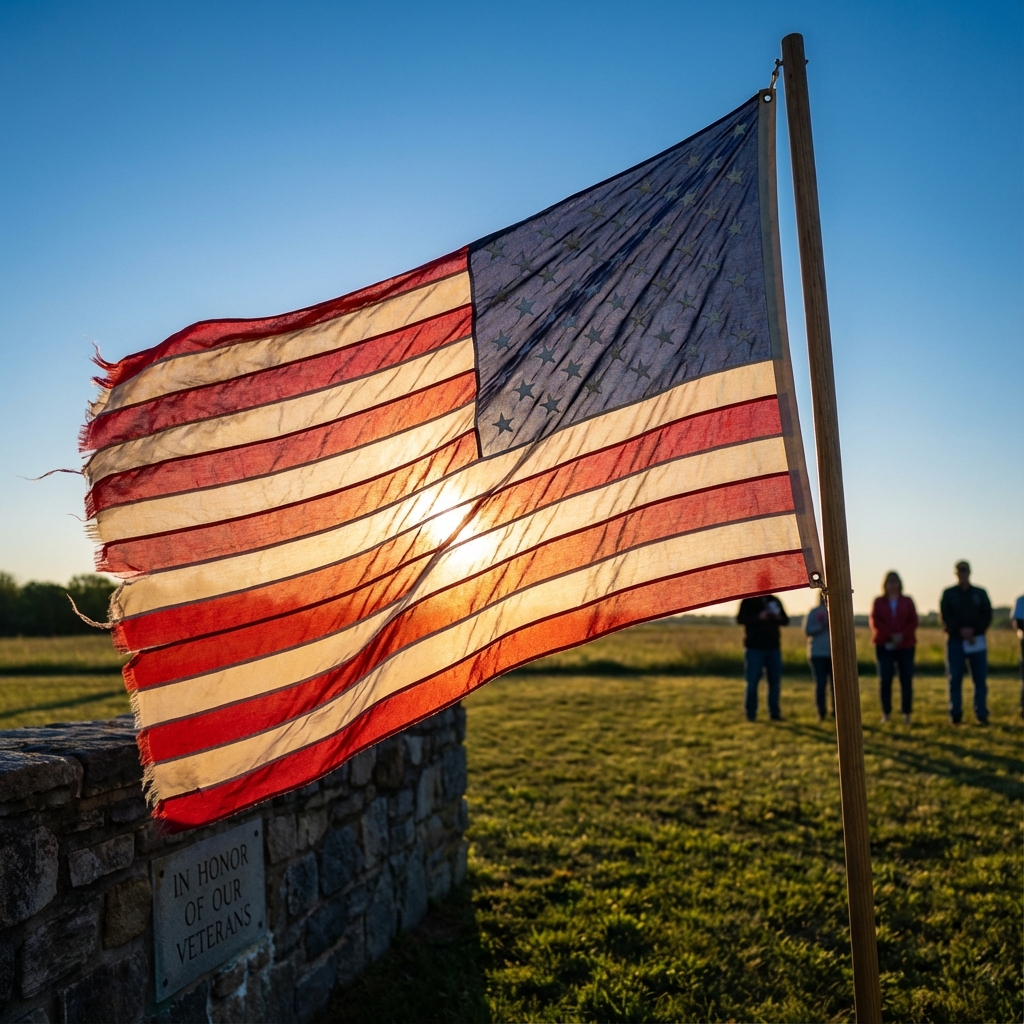
Rain or shine, summer or winter, his ancient hands pulled the rope as the stars and stripes rose against the sky. He’d been doing it since 1973 — the year he came home from Vietnam, the year he bought this house, the year he decided some things mattered enough to do daily.
His neighbors barely noticed anymore. Just part of the landscape.
Then Aisha moved in next door.
She was eight and curious about everything.
“Why do you do that every day?” she asked, appearing at the fence the first week.
“Because I served,” Mr. Kowalski said. “And this helps me remember why.”
“Remember what?”
He considered how to explain to a child. “That freedom isn’t free. That people gave things up so we could have what we have.”
“Did you give things up?”
Mr. Kowalski’s knee ached. His ears rang sometimes from artillery he’d heard fifty years ago. He dreamed, occasionally, of things he wished he couldn’t remember.
“Some things,” he said. “But I was one of the lucky ones. I came home.”
*
Aisha started watching the flag ceremony every morning.
At first, just from her window. Then from her porch. Then, eventually, from the edge of his lawn, waving hello.
“You’re very punctual,” Mr. Kowalski observed.
“Mom says that means on time.”
“Your mom is correct.”
“Why do you put it down at night?”
“Flag protocol. Sunrise to sunset, unless you have a light on it.”
Aisha absorbed this. She was the kind of child who absorbed everything, filing it away for future use.
*
On Veterans Day, Aisha knocked on his door.
She was holding a card — construction paper, glitter, a drawing of a flag that looked more like a striped rectangle with dots.
“Happy Veterans Day,” she said solemnly. “Thank you for your service.”
Mr. Kowalski’s throat tightened. He’d heard those words before, at parades, at ceremonies, from politicians who didn’t really mean them.
But from this eight-year-old, in her crayon handwriting, it meant something different.
“Thank you,” he said. “Would you like to help me raise the flag today?”
Her face lit up. “Can I?”
“Veterans Day seems like the right occasion.”
They raised it together.
His hands guided hers on the rope. Together, they pulled slowly, the flag climbing into the gray November sky.
“Now we salute,” he said.
Aisha put her hand over her heart, close enough. Mr. Kowalski raised his hand to his forehead, crisp as it had been at twenty.
They stood in silence as the flag snapped in the wind.
“How do you feel?” he asked.
“Important,” Aisha said. “Like I’m part of something.”
“You are. We all are. That’s the whole point.”
*
Every Veterans Day after that, Aisha helped.
She was nine, then twelve, then fifteen. Too cool for most things, but never for this.
“People at school don’t care about Veterans Day,” she said one year.
“They don’t have to care. That’s the freedom we fought for. They get to ignore it if they want.”
“Doesn’t that make you mad?”
“Sometimes. But mostly I’m just glad they can. That they live in a world where war seems far away.” He paused. “I hope it stays that way for you.”
*
When Mr. Kowalski passed away at ninety-two, Aisha was twenty-three.
She’d just finished her first year of law school. She came home for the funeral, for the military honors, for the folded flag his daughter accepted with trembling hands.
The next morning, at 7 AM, she stood in front of his empty house.
The flag was still there. The rope still waited.
She raised it herself — slow, steady, just the way he’d taught her. She saluted, hand over heart turning to forehead, the way she’d learned at eight.
And she knew, standing there in the November cold, that she’d keep doing this. Every morning if she could. Every Veterans Day for certain.
Because Mr. Kowalski had given her something, not just skills, but purpose. The understanding that small rituals could carry enormous weight.
The flag snapped in the wind. She’d learned to hear it almost like a voice.
Thank you, it seemed to say. Don’t forget.
She wouldn’t. She never would.
