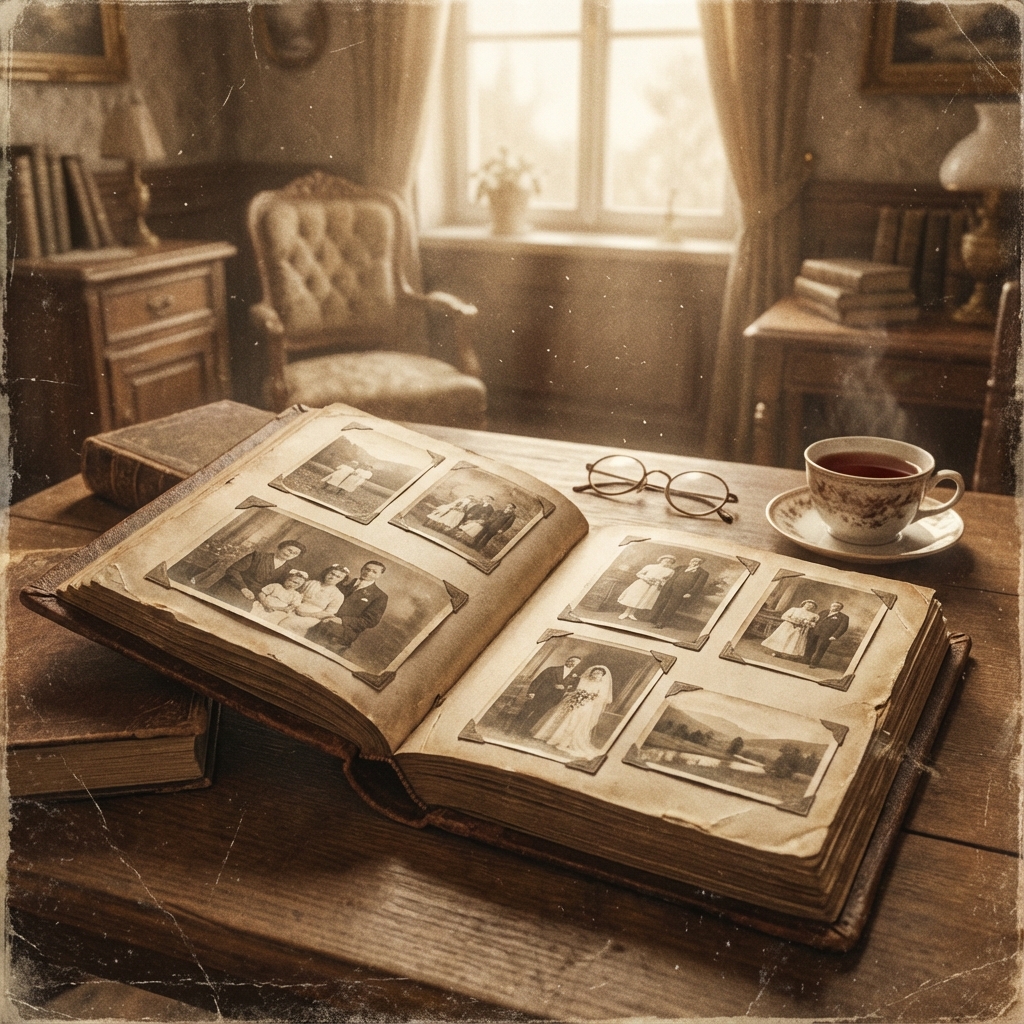
Grace found the album in the attic, buried under boxes of Christmas decorations.
It was old — the kind with pages that stuck together, photos held in place by yellowed corner mounts. The cover was cracked leather, no title, no name.
She didn’t recognize anyone inside.
*
The photos were from another era.
Black and white at first, then faded color. A young couple at a beach. A child in a wagon. Two women standing arm in arm, squinting at the sun.
On the back of one photo, handwriting: Marie and Ruth, summer 1952.
Grace had no idea who Marie and Ruth were. This house had been in her family for three generations, surely the album belonged to someone in her lineage.
But none of these faces matched the portraits she’d seen in family bibles and scrapbooks.
A mystery. She loved a mystery.
*
She started with the handwriting.
Her grandmother had passed years ago, but her grandfather was still sharp at ninety-three. She drove to the nursing home with the album in her bag.
“Marie and Ruth,” Grandpa said, smoothing his hand over the photo. “Haven’t heard those names in seventy years.”
“Who were they?”
“They lived next door. Before the war. Ruth was my sister’s age, they were inseparable. Marie was Ruth’s mother.”
“What happened to them?”
Grandpa’s face clouded. “Ruth and her father were killed in a car accident. 1954, I think. Marie moved away after that. Never came back.”
Grace looked at the photo, two women, smiling, unaware of what was coming.
“How did this album end up in our attic?”
“I don’t know.” Grandpa shook his head. “Maybe Ruth gave it to my sister. Maybe it got mixed up in the chaos after. Things get lost.”
*
Grace became obsessed.
She traced Marie’s family tree through online records, found distant relatives, made awkward phone calls. Most led nowhere. But one, a great-niece in Oregon, remembered something.
“My grandmother mentioned her mother’s best friend,” the woman said. “A girl who died young. She kept a photo of them on her dresser until the day she died.”
“Ruth,” Grace said.
“Maybe. I never knew the name.”
“Did your grandmother ever go back? To the town, I mean?”
“No. She said it hurt too much.”
*
Grace drove three hours to a cemetery she’d never visited.
She found Ruth’s grave near the edge; a small headstone, weathered but legible. Ruth Ellen Morris, 1938-1954. Beloved daughter.
There were no flowers, no signs of recent visitors. Just grass and silence and the weight of forgotten years.
Grace laid a photo on the stone, the one of Marie and Ruth, summer 1952. Two women who didn’t know what was coming, frozen forever in sunlight.
“I don’t know if anyone’s been here in a long time,” she said aloud. “But I’m here now. And I’m going to make sure you’re not forgotten.”
*
She returned the album to Marie’s great-niece.
They met in a coffee shop halfway between them, two strangers connected by a photograph and a shared need for closure.
“This belonged to your family,” Grace said, sliding it across the table. “I think your grandmother would have wanted it back.”
The woman, Ellen, opened to the first page and began to cry.
“That’s her,” she said, touching a photo of Marie as a young bride. “That’s my grandmother. I’ve never seen her this young.”
“She was beautiful.”
“She had a hard life. Lost so much.” Ellen looked up. “Thank you. For finding this. For caring.”
“Thank you for answering my calls. Most people would have thought I was crazy.”
“Maybe you are.” Ellen smiled through her tears. “But you’re the good kind of crazy.”
*
Grace made copies of some photos before giving the album away.
She hung one in her hallway: Marie and Ruth, summer 1952. A reminder that strangers have stories too. That boxes in attics contain more than dust. That sometimes, the people who came before us are waiting to be remembered.
All we have to do is look.
Photo Album – Flash Fiction – August 24, 2026