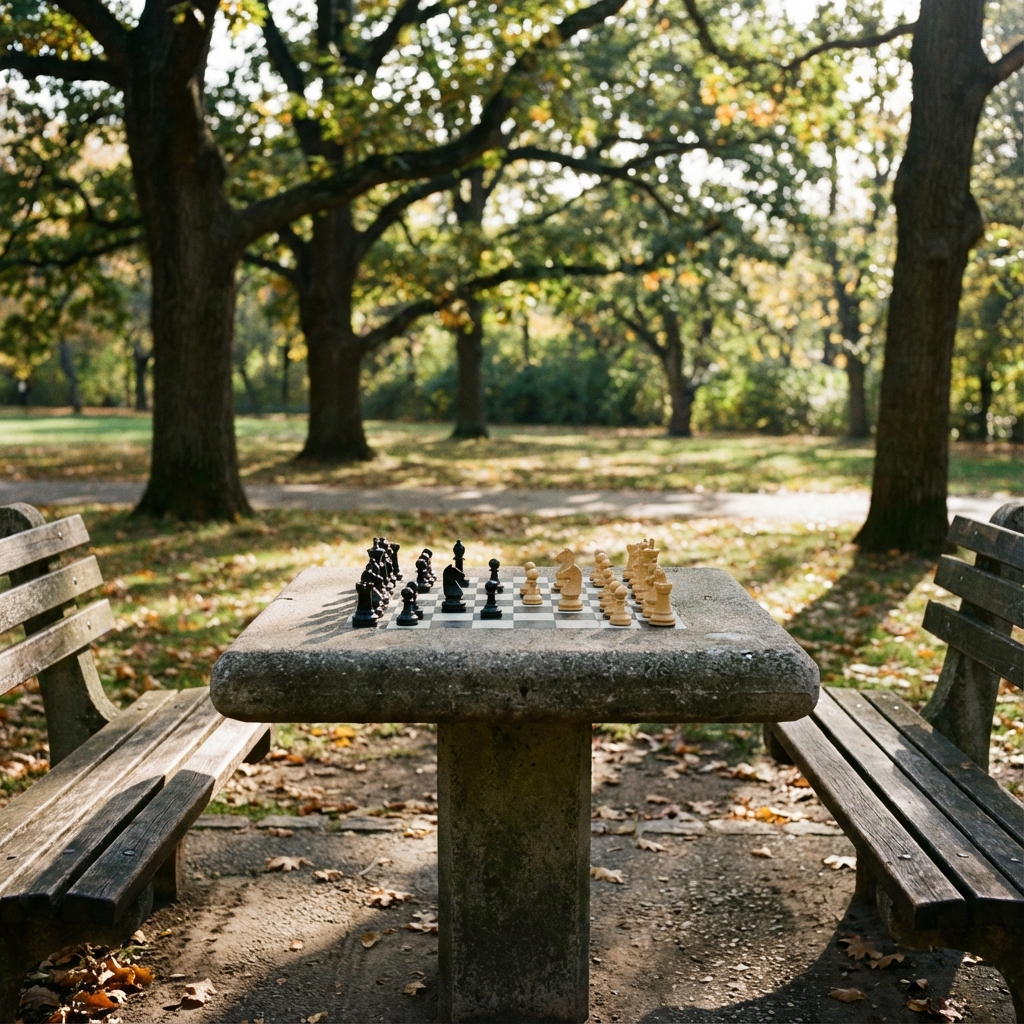
Harold set up his board at the same bench every day: the one under the big oak, third from the fountain.
He’d been coming here for twelve years, since retirement, playing against whoever showed up. Some days it was retirees like himself. Some days it was tourists who didn’t realize what they were getting into. Some days it was nobody at all, and Harold played against himself, moving pieces on both sides, losing on purpose to keep things interesting.
Today, it was a teenager.
The kid had been circling the bench for ten minutes, pretending to be interested in something else. Harold waited. Patience was part of the game.
“You play?” the kid finally asked.
“Every day. You?”
“A little.” The kid sat down, eyeing the board. “My dad taught me. Before he—” He stopped. “Before.”
Harold understood “before.” He’d had plenty of befores in his life.
“I’m Harold.”
“Eli.”
“Well, Eli. You got anywhere to be?”
The kid shook his head.
“Then let’s play.”
*
Eli was terrible.
His openings were sloppy, his middle game was chaotic, and he had a habit of pushing pawns for no strategic reason. He lost in eighteen moves.
“Again?” Harold asked.
Eli blinked, surprised. “You want to play again?”
“Got somewhere to be?”
“No.”
“Then again.”
They played four games. Eli lost all four, but by the end, he was losing slower. He was starting to think, to see the board as a whole instead of a series of disconnected moves.
“Tomorrow?” Harold asked, packing up the pieces.
“You serious?”
“Every day at three. Same bench. Be here if you want to learn.”
*
Eli came back.
Day after day, week after week, he lost. But he improved. Harold taught him openings — the Italian Game, the Queen’s Gambit, the Sicilian Defense. He taught him to think three moves ahead, then five, then seven.
Between games, they talked.
Harold learned that Eli was fifteen, that he lived with his grandmother, that his father had died two years ago and his mother had moved away. He was angry at the world but didn’t know what to do with the anger, so he carried it like a stone in his pocket.
Eli learned that Harold had been an accountant, that his wife had passed away six years ago, that chess was the thing that got him out of bed most mornings.
“Why?” Eli asked.
“Because it’s a problem I can solve. Life throws things at you that you can’t control. Chess, you can control. Every move is a choice.”
Eli nodded slowly. “I don’t feel like I have any choices.”
“You chose to come here today. You chose to sit down. You chose to play.” Harold set up the pieces. “Every choice leads to another choice. That’s the whole point.”
*
The first time Eli won, it was a shock to them both.
Harold had made a mistake — a genuine one, not thrown — and Eli had seen it. Exploited it. Three moves later, checkmate.
“Holy—” Eli caught himself. “I won.”
“You won.”
“I actually won!”
Harold smiled, the first full smile Eli had seen from him. “Don’t get cocky. Best two out of three.”
Eli won the second game too. The third was a draw.
“You’ve got talent,” Harold admitted. “Real talent. You should join the chess club at school.”
Eli’s face darkened. “I don’t do school stuff.”
“Why not?”
“Because it’s stupid. It’s all stupid.”
Harold studied him. “No, it’s not. You’re just scared.”
“I’m not scared—”
“You’re scared of caring about things. Because things you care about can be taken away.” Harold’s voice was gentle. “I know something about that.”
Eli was silent for a long time.
“The chess club meets Tuesdays and Thursdays,” Harold said. “Just think about it.”
*
Two weeks later, Eli walked into Harold’s park bench wearing a school chess team T-shirt.
“Don’t say anything,” he muttered.
Harold just smiled and set up the board.
*
Three years passed. Eli graduated high school with a scholarship — not for chess, but for academics. It turned out that when you learned to think seven moves ahead, schoolwork got easier.
He came to the park bench one last time before leaving for college.
“I couldn’t have done any of this without you,” he said.
“You did all of it yourself. I just taught you the openings.”
“You taught me more than that.”
Harold shook his head. “I taught you chess. You figured out the rest.”
They played one final game. Eli won.
“Best two out of three?” Harold asked.
“Next time I’m home.”
They shook hands — the first time they’d ever done that instead of just nodding goodbye.
Harold watched the kid walk away, not a kid anymore. Then he set up the board and waited for whoever would come next.
The bench was still there. The oak was still there. And Harold, patient as always, was ready to teach whatever lost soul needed finding.
Chess in the Park – Flash Fiction – June 29, 2026