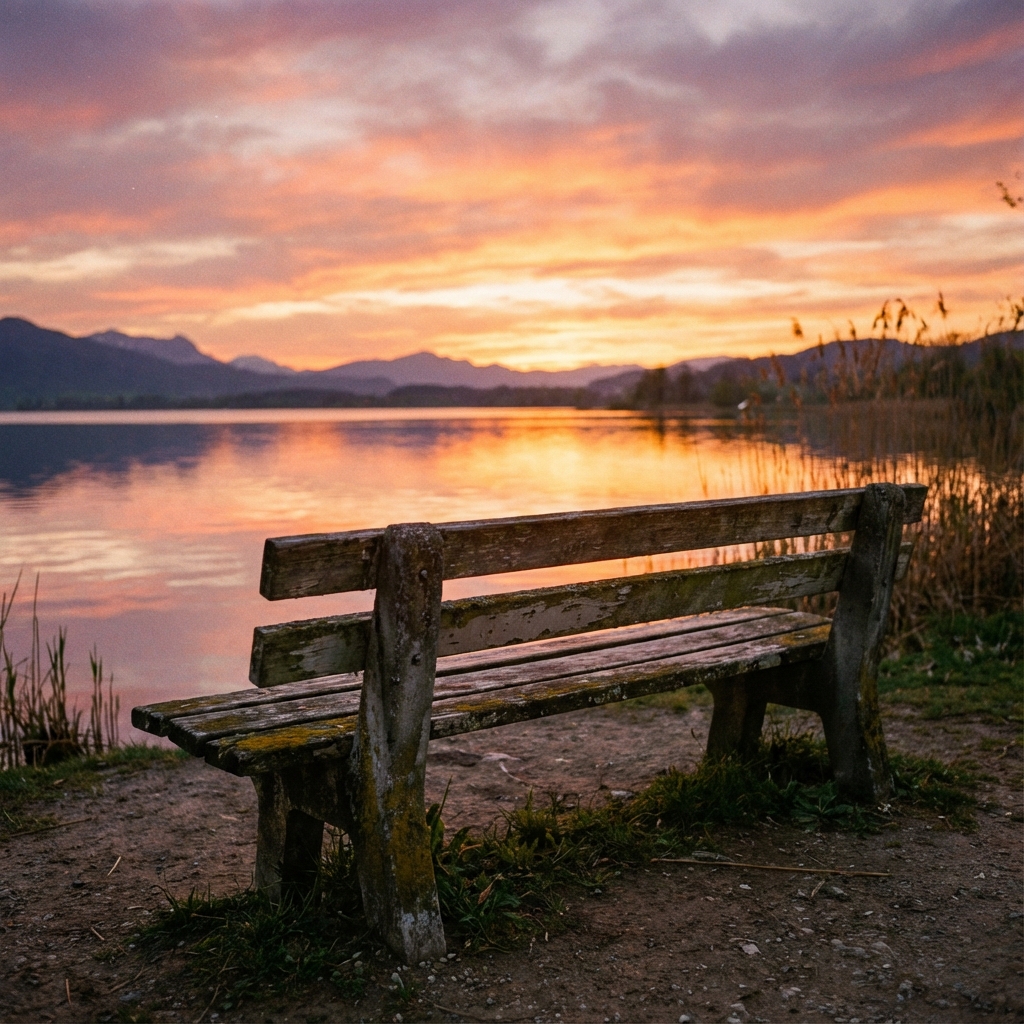
The huge bench Walter discovered faced west.
He’d been walking the trails in Hillcrest Park every evening since Margaret passed, and one day he’d stayed too long and realized the sun was setting. He sat down on the nearest bench to watch, and something in him eased for the first time in months.
He came back the next day. And the next.
By the end of the first week, he’d started thinking of it as “his” bench. Which is why he was mildly annoyed when, on day eight, he found a woman already sitting there.
“Oh,” she said, looking up. “Am I in your spot?”
Walter hesitated. It wasn’t his spot, really. It was a public bench in a public park. He had no claim on it.
“No,” he said stiffly. “It’s fine.”
He sat on the opposite end, as far from her as possible, and stared straight ahead at the horizon. The sun was still twenty minutes from setting. The silence stretched awkwardly.
“I’m June,” the woman said eventually. “I started coming here after my divorce. Watching the sunset helps me remember that endings can be beautiful.”
Walter didn’t respond at first. Then: “Walter. My wife died in February.”
“I’m sorry.”
“Thank you.”
They watched the rest of the sunset without speaking. But the silence was different now — less awkward, more companionable. When the last light faded, June stood, nodded at Walter, and walked away.
She was there again the next evening. So was Walter.
* * *
By the end of the month, there were four of them.
June came for her divorce. Walter came for his grief. And then there was Priya, a night shift nurse who said the sunsets helped her decompress before going to work. And Miguel, a retired firefighter who didn’t explain why he came, but always arrived with a thermos of coffee and enough cups for everyone.
They didn’t plan it. There were no invitations, no group text, no formal agreement. They just kept showing up at the same time, on the same bench, and eventually it became a ritual.
“We should have a name,” June said one evening, watching the clouds turn pink and gold. “Every club needs a name.”
“We’re not a club,” Walter said gruffly. But he was smiling, which he’d started doing more often lately.
“The Sunset Club,” Priya suggested. “Simple. Accurate.”
Miguel raised his coffee cup. “I second the motion.”
And so they became the Sunset Club, strangers who met every evening on a bench in Hillcrest Park to watch the day end and share whatever needed sharing.
* * *
The conversations started small.
Weather. Sports. Complaints about traffic. The kind of surface talk that strangers exchange without really connecting.
But sunsets have a way of opening people up. There’s something about the dying light, the way the world goes soft and golden, that makes it easier to say true things.
Priya talked about the patient she’d lost last week, and how she still saw his face when she closed her eyes. June admitted that she missed her ex-husband sometimes, not the man he’d become but the man he used to be. Miguel finally explained that his wife had Alzheimer’s, and the sunsets were his only hour of peace before going home to care for her.
And Walter, who hadn’t cried since Margaret’s funeral, found himself weeping openly one October evening while the others sat with him in silence, bearing witness to a grief he’d been carrying alone.
“I miss her so much,” he said, voice breaking. “Fifty-two years, and now I don’t know who I am without her.”
June reached over and took his hand. Priya put a hand on his shoulder. Miguel poured him more coffee.
No one said “it gets better” or “she’s in a better place” or any of the hollow things people say when they don’t know what to say. They just stayed. They watched the sun disappear. They waited until Walter was ready to walk home.
That was the night the Sunset Club became something more than strangers on a bench.
* * *
Over the next year, they expanded.
A college student named Derek started joining them after his late classes, grateful for company that didn’t expect him to be anything but present. An elderly widow named Harriet brought homemade cookies and stories about the park from decades ago, when it was still farmland.
They celebrated Miguel’s wife’s good days and mourned her bad ones. They threw a small party when Priya got promoted. They helped June move into her new apartment, the first place that was truly hers.
And Walter, slowly, started living again. He began bringing his camera to the bench, photographing the sunsets that had saved him. One of his photos ended up in a local gallery exhibition. Another became the cover of a community calendar.
“Margaret would have loved this,” he told June one evening, showing her a shot he was particularly proud of : the sun sinking behind the trees, silhouettes of their little group visible on the beloved bench.
“Maybe she sent you here,” June said. “To find us.”
Walter considered this. He wasn’t sure he believed in signs or messages from beyond. But he believed in showing up. He believed in strangers becoming friends becoming family. He believed in endings that made room for beginnings.
“Maybe she did,” he said.
* * *
The bench eventually got a plaque. The parks department installed it after one of Harriet’s granddaughters wrote a letter to the city council.
The Sunset Club Bench
Where strangers become friends
And endings become beautiful
Walter ran his fingers over the engraved words, tears pricking at his eyes again, but happy tears this time. Behind him, he could hear June laughing at something Derek said, Priya arguing good-naturedly with Miguel about whether the coffee was strong enough, Harriet passing out her famous oatmeal cookies.
The sun was starting its descent, painting the sky in colors that no camera could quite capture.
Walter sat down in his usual spot — his spot now, officially, sanctioned by a plaque — and smiled.
He’d come to this bench looking for a place to grieve. He’d found a place to live.
