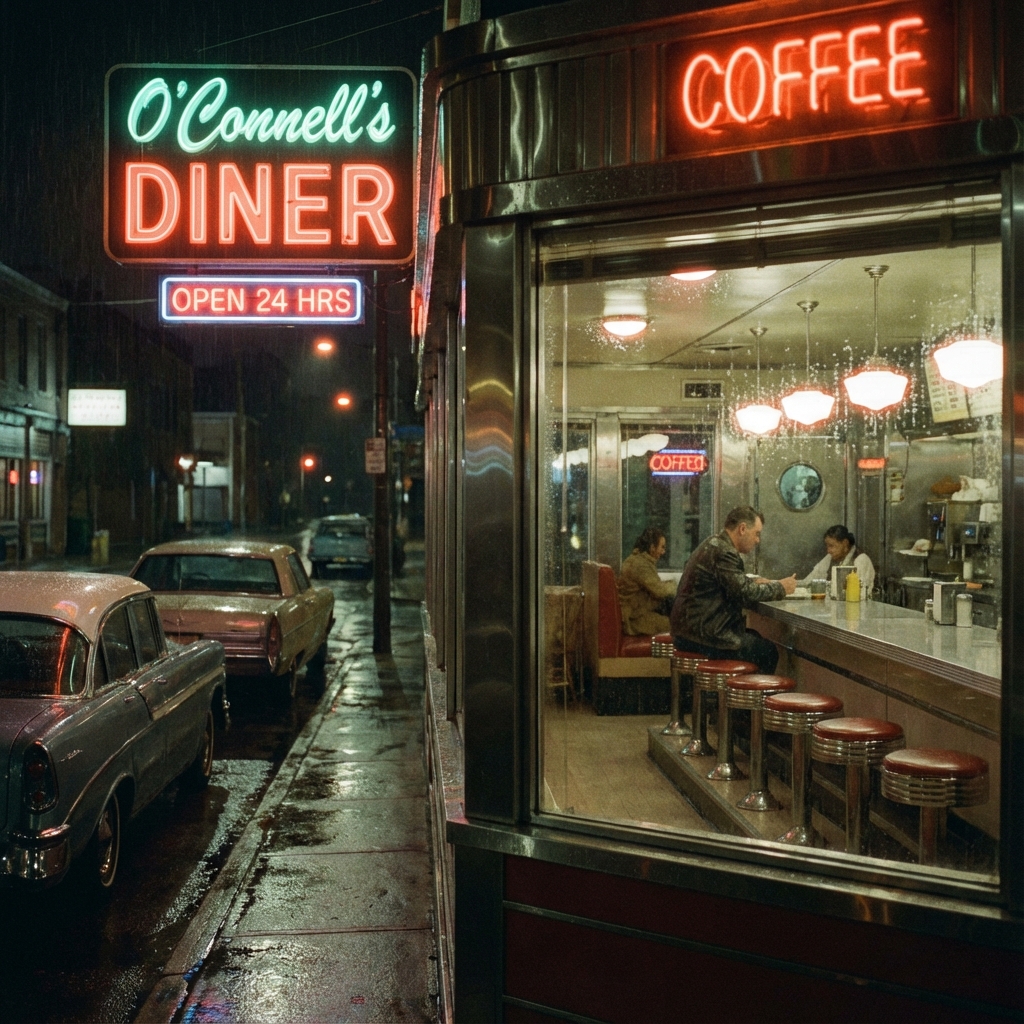
The Moonlight Diner never closed.
That was the rule, painted on a sign above the door in faded gold letters: Open 24 Hours — Because Someone’s Always Hungry. During the day, it was just another greasy spoon — truckers and tourists, families splitting stacks of pancakes. But after midnight, the diner belonged to the regulars.
Carla, the night shift waitress, knew them all by heart.
Booth one: Vincent, a long-haul trucker who rolled in around 2 AM every Wednesday and Saturday, always ordering the same thing (scrambled eggs, rye toast, coffee black enough to strip paint). He rarely spoke but left twenty-dollar tips folded under his plate.
Booth three: Nadia, a nurse from the hospital downtown, still in scrubs when she arrived at 4 AM after her shift. She ordered decaf (which Carla never understood, what was the point?) and a slice of whatever pie was left. She cried sometimes, quietly, into her napkin. Carla never asked why.
Counter seat six: Steven, a writer who claimed he was working on a novel but spent most of his time staring at a laptop screen that never seemed to change. He ordered endless refills of regular coffee and occasionally read passages aloud to whoever would listen. Nobody ever listened, but nobody told him to stop either.
Booth seven: Eleanor, an elderly woman who simply couldn’t sleep anymore and preferred company to an empty apartment. She ordered hot water with lemon and a small bowl of fruit, and she told stories about her late husband, Harold, who’d been a jazz musician in the 1960s. Carla had heard every story a million times but listened each time like it was new.
And then there was Carla herself, who’d been working the night shift for twelve years because she couldn’t stand the silence of her own empty house and she liked being useful in the hours when most people were dreaming.
They weren’t friends, exactly. Not in the daylight sense of the word. They didn’t know each other’s phone numbers or birthdays, didn’t exchange Christmas cards or attend each other’s weddings. But there was something else, a late-night understanding, a shared citizenship in the country of sleeplessness.
So when Vincent didn’t show up one Wednesday, everyone noticed.
“Probably just running late,” Steven muttered, not looking up from his laptop.
But by 4 AM, his booth was still empty, and a strange tension had settled over the diner. Nadia kept glancing at the door. Eleanor stirred her water without drinking it. Even Steven had stopped pretending to write.
“Maybe he’s sick,” Nadia offered.
“Vincent doesn’t get sick,” Eleanor said. “He’s the healthiest man I’ve ever seen at 3 AM. Says it’s all the driving, keeps his blood moving.”
Carla refilled coffee cups and tried not to worry. People missed nights all the time. Life happened. Routes changed. Trucks broke down.
But Vincent had been coming to the Moonlight Diner for eight years, and she couldn’t remember a single Wednesday he’d missed.
At 5 AM, the door swung open, and everyone’s head turned.
It wasn’t Vincent. It was a younger man, early thirties, with Vincent’s same square jaw and tired eyes.
“Excuse me,” he said, approaching the counter. “I’m looking for… my dad mentioned this place. Vincent Reilly? Big guy, trucker, comes in on Wednesdays?”
Carla’s stomach dropped. “That’s his booth,” she said, pointing. “He’s a regular. Is he okay?”
The man, Vincent’s son, it had to be, swallowed hard. “He had a heart attack on Monday. He’s in the hospital now. Stable, but…” He trailed off, looking around the diner like he was trying to see it through his father’s eyes.
“He asked me to come,” the son continued. “When he woke up, the first thing he said was ‘Tell the Moonlight I’m okay.’ I thought he was confused, but he kept insisting. Said there were people who’d worry.”
Carla felt tears prick at her eyes. “He was right.”
For a moment, no one spoke. Then Eleanor rose from her booth, crossed the diner, and pressed a paper napkin into the young man’s hand.
“You tell Vincent that his booth will be waiting when he’s ready,” she said firmly. “And that Carla makes the best scrambled eggs on the Eastern Seaboard. He’d better come back for them.”
The son laughed, surprised. “I’ll tell him.”
Nadia dug in her purse and produced a pen. “Here’s my number. I’m a nurse, if he needs anything, or if you just need someone to talk to, call me.”
Steven tore a page from his ever-unused notebook. “Tell him we’re all rooting for him. And that I finally finished chapter three.”
One by one, they gathered around Vincent’s son with messages, phone numbers, offers of help. A man they didn’t really know, for a trucker they’d never spoken to outside the hours between midnight and dawn.
When the son finally left, the diner fell quiet again. But it was a different kind of quiet now, warmer, somehow.
“Well,” Eleanor said, settling back into her booth. “I suppose we’re all friends after all.”
Carla smiled, refilling her mug of hot water. “I suppose we are.”
Vincent came back six weeks later, thinner and a little slower, but grinning when he walked through the door at 2 AM sharp. His booth was ready, his eggs were perfect, and the following week, Eleanor baked him a cake that said Welcome Back in slightly lopsided frosting.
He looked around at them all, the truck stop waitress, the exhausted nurse, the blocked writer, the sleepless widow, and his eyes went shiny.
“You people,” he said gruffly. “You really are something.”
“We’re night owls,” Carla said simply, setting down his coffee. “We look out for each other.”
And they did. Every Wednesday and Saturday, without fail, until the end.
