Dr. Elena Reyes hadn’t felt excited about the ocean in two years.
This was a problem, considering she’d devoted her entire career to marine biology. Fifteen years of research, three published papers on intertidal ecosystems, a PhD that had once felt like the greatest accomplishment of her life, and now she could barely stand to look at the water.
Burnout, her therapist called it. “You’ve given so much to your work that you’ve forgotten why you started,” she’d said. “Maybe it’s time to step back. Remember what drew you in the first place.”
So Elena had taken a leave of absence, moved into a rented cottage overlooking the coast, and spent three weeks feeling guilty about not working. The waves mocked her through the window day after day.
She was considering renting a car and driving somewhere landlocked when the knock came.
Her neighbor’s daughter, Sophie, stood on the porch. She was seven years old, all wild curly hair and gap-toothed grin, and she was holding a bright pink bucket.
“My mom said you’re a scientist,” Sophie announced without preamble. “She said you know about tide pools.”
Elena hesitated. “I used to study them, yes.”
“Can you show me?” Sophie hoisted the bucket hopefully. “I’ve never seen one. I want to find a sea star.”
A dozen excuses formed in Elena’s mind. She was on leave. She wasn’t in the right headspace. She didn’t have the energy to be educational.
But Sophie was looking at her with such earnest expectation that Elena found herself saying, “Let me get my boots.”
–
They walked down to the rocks at low tide, Sophie chattering the entire way about sea creatures she’d seen in books and movies. Elena offered occasional corrections — “Actually, starfish are called sea stars because they’re not fish” — and was surprised to find they didn’t feel like work.
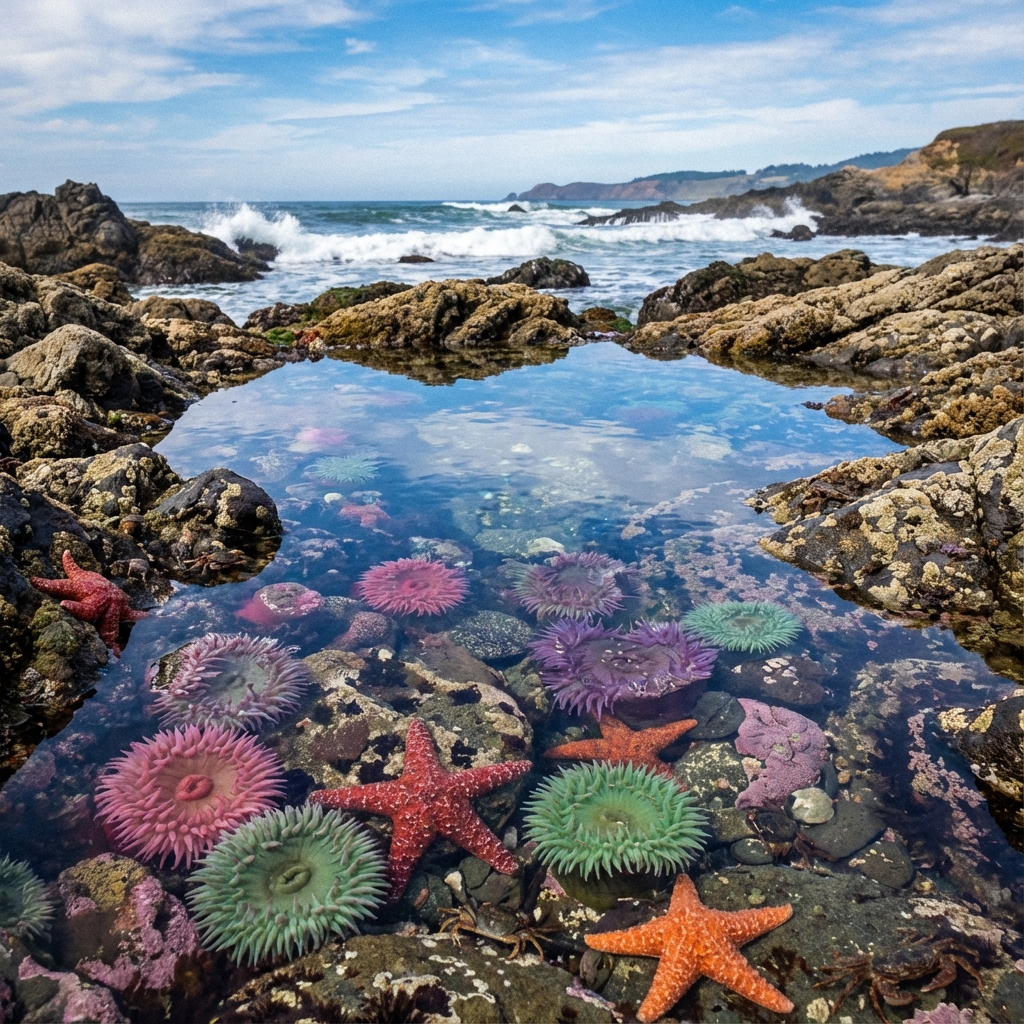
The tide pools revealed themselves as they climbed over the rocks, shallow bowls of trapped ocean teeming with life. Sophie gasped at the first one, dropping to her knees.
“It’s like a tiny world!”
Elena knelt beside her, her jeans soaking through on the wet stone. She pointed out the hermit crabs shuffling in their borrowed shells, the anemones waving their soft tentacles, the limpets clinging stubbornly to rock.
“Everything here is waiting for the water to come back,” Elena explained. “They’ve learned to survive in between. It’s one of the hardest environments on earth, sometimes underwater, sometimes exposed. They have to be incredibly tough.”
“Like superheroes,” Sophie declared.
“Exactly like superheroes.”
They found sea stars in the third pool, two ochre stars clinging to the shadowed underside of a rock, their arms radiating outward like slow-motion fireworks.
“Can I touch?” Sophie whispered.
“Very gently. One finger.”
Sophie reached out, barely grazing the textured surface. Her face transformed into something like reverence.
“It feels like bumpy velvet,” she said. “Like it’s wearing armor made of tiny bumps.”
Elena smiled. She’d written papers about the ossicles in sea star skin, the hydraulic system that powered their tube feet, the remarkable ability of some species to regenerate lost limbs. But she’d forgotten this, the simple wonder of first contact.
“Want to know a secret?” Elena said.
Sophie nodded eagerly.
“Sea stars don’t have blood. Instead, they pump seawater through their bodies. The ocean literally flows through them.”
Sophie’s eyes went impossibly wide. “So they’re made of the ocean?”
“In a way, yes.”
“That’s the coolest thing anyone’s ever told me.”
They explored for two hours. Elena identified creatures she hadn’t thought about in months, chitons and nudibranchs, sculpins and shore crabs. Sophie absorbed it all with the fierce attention of someone for whom the world was still endlessly surprising.
By the time they climbed back up to the path, the tide was starting to turn, water creeping back into the pools they’d explored.
“Will the sea stars be okay?” Sophie asked, looking back.
“They’ll be fine. The ocean always comes back for them.”
Sophie was quiet for a moment. Then: “Dr. Elena? Can we do this again?”
Elena looked at the girl, her pink bucket now containing a collection of empty shells she’d gather for inspection. She looked at the ocean, no longer mocking her but sparkling in the late afternoon sun. She thought about the sea stars, waiting patiently for the tide to return, surviving the in-between.
“Yes,” she said. “I’d like that.”
–
Elena renewed her leave for another month. Then another. She started writing again — not research papers, but observations. Field notes with drawings. Something that felt more like poetry than science.
She took Sophie to the tide pools every week. Sometimes Sophie’s mom came too. Sometimes other kids from the neighborhood joined them, and Elena found herself teaching again, but differently this time. Slower. Softer. More wonder, less data.
One afternoon, watching Sophie carefully return a hermit crab to its home pool, Elena realized her therapist had been right. She’d lost sight of the beginning. The first tide pool she’d ever explored, at age six, with her own grandmother. The shock of discovering that the world contained so much life, just waiting to be noticed.
Sophie ran back to her, face glowing. “I want to be a scientist when I grow up. Like you.”
“Then I’ll teach you everything I know,” Elena said.
The ocean rushed and retreated, an endless rhythm. The sea stars clung to their rocks, waiting.
And for the first time in years, so was Elena — waiting for the tide to come back in, knowing now that it always would.
Published Feb 23 2026
